
U.S. EIN for a UK Limited Company: Treaty Forms, Subsidiaries and SS-4
A practical guide to U.S. EIN requirements for UK limited companies. Learn how parent companies, U.S. subsidiaries, the U.S.–UK tax treaty, and Companies House name details affect the application.
- #Form SS-4
- #U.S. EIN for UK Company
- #UK Limited Company
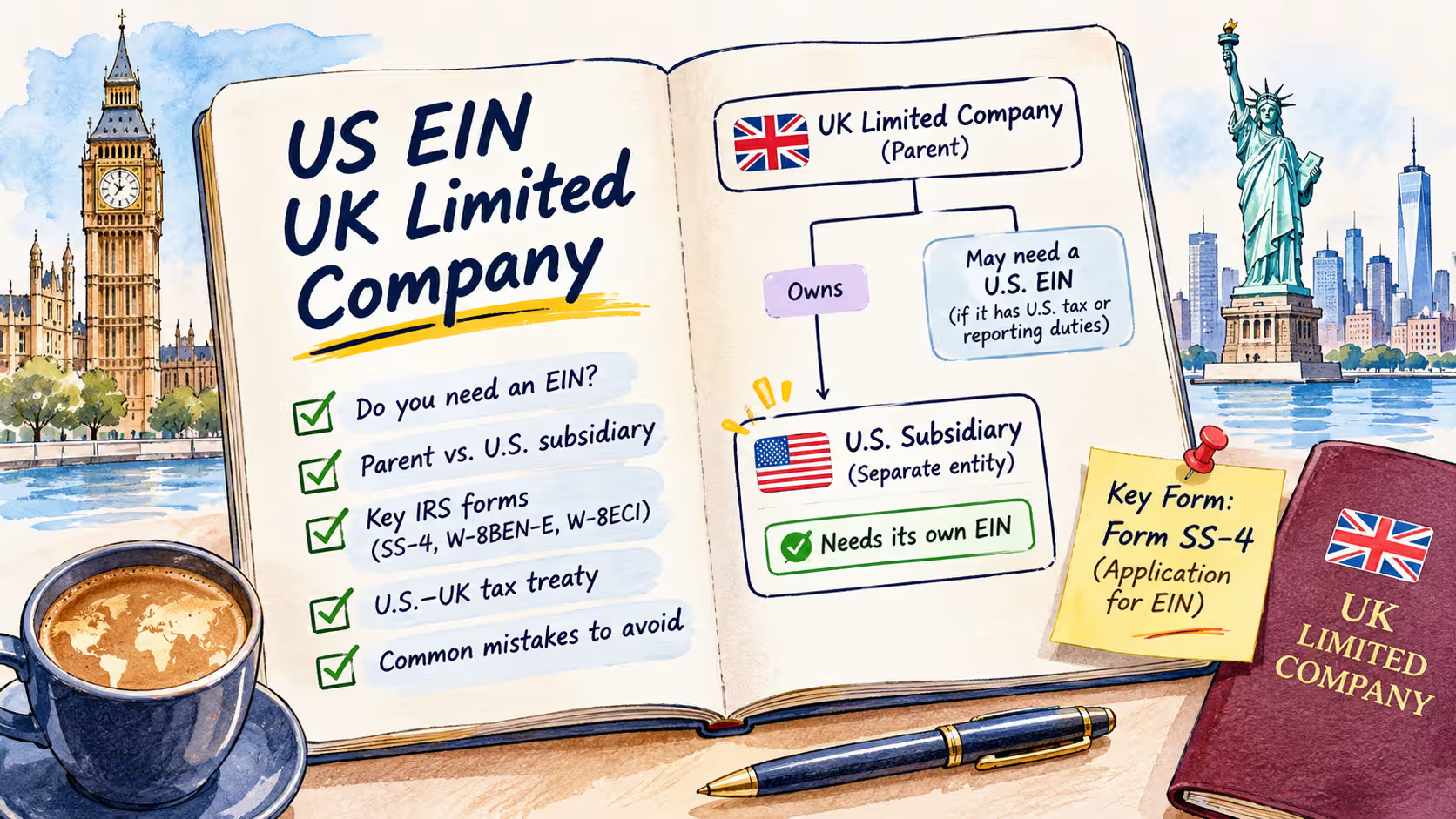
If you are researching a us ein uk limited company application, the first step is to understand whether your UK business actually needs a U.S. Employer Identification Number (EIN). Having U.S. customers or owning a U.S. subsidiary does not automatically mean the UK company needs one.
This us ein uk limited company guide explains when an EIN may be required, how parent companies and subsidiaries are treated, and how to apply using Form SS-4. It also covers U.S.-UK tax treaty forms and common application mistakes.
1. US EIN UK Limited Company: Does Your Business Need One?
A UK limited company may need a U.S. EIN if it has a U.S. tax filing or reporting obligation, needs to register for certain federal tax activities, or has another valid reason for obtaining the number.
It may need an EIN in situations such as:
- The company must file a U.S. federal tax return.
- It has employees and needs to report employment taxes.
- It must file certain U.S. information or excise tax forms.
- A U.S. bank, payer, or business partner requests an EIN for a valid tax or reporting purpose.
- The company is establishing a U.S. business entity that needs its own EIN.
However, a UK company does not automatically need an EIN just because it sells to U.S. customers, receives payments from American clients, or has a U.S. business relationship.
Understanding UK limited company EIN requirements starts with identifying the company's U.S. tax, withholding, or reporting responsibilities. Not every UK business needs a U.S. EIN simply because it works with American customers.
2. UK Parent Company vs. U.S. Subsidiary
A UK parent company and its U.S. subsidiary are generally separate legal entities when the subsidiary is incorporated as a separate corporation. Each company must consider its own EIN requirements.
UK limited company acting as the parent
A UK Ltd may own shares in a U.S. corporation. The UK parent does not automatically need an EIN only because it owns the American company.
The parent may need an EIN if it has its own U.S. tax filing, withholding, reporting, or other valid federal tax requirement.
U.S. subsidiary
A separately incorporated U.S. subsidiary generally needs its own EIN for federal tax administration. It should not use the UK parent's tax number as a replacement.
An EIN for UK parent company operations is separate from the EIN assigned to its U.S. subsidiary. The parent and subsidiary must use their own tax identification details when required.
Even when a group files a consolidated U.S. corporate tax return, each corporation in the affiliated group generally keeps its own EIN.
Simple example
Imagine a UK company called ABC Holdings Ltd owns all the shares of ABC USA Inc.
- ABC Holdings Ltd: The UK parent may need a U.S. EIN if it has a separate U.S. tax or reporting requirement.
- ABC USA Inc: The U.S. subsidiary generally needs its own EIN.
The two companies should maintain separate legal, tax, and financial records.
3. UK Company U.S. Tax ID: Is an EIN Always Required?
A UK company U.S. tax ID request does not always mean the company must apply for an EIN. The correct document depends on the payment, the company's tax status, and the reason for the request.
A U.S. customer or financial institution may request tax documentation before making payments or opening an account. Depending on the facts, the UK company may provide an appropriate IRS tax form instead of applying for an EIN.
Common tax documents
- Form W-8BEN-E: Generally used by a foreign entity to certify its foreign status and, where applicable, claim treaty benefits.
- Form W-8ECI: Used by a foreign person or entity to certify that specified income is effectively connected with a U.S. trade or business, subject to the form's requirements.
- Form W-9: Generally used by U.S. persons, including certain U.S. entities.
- Form SS-4: The IRS application used to request an EIN.
A UK company that is the beneficial owner of income may generally use Form W-8BEN-E when appropriate. The form does not automatically replace an EIN where the company has a separate requirement to obtain one.
Before applying, ask the U.S. payer why it needs the number. It may need an EIN for its reporting process, or it may simply need the correct foreign tax form.
4. U.S.-UK Tax Treaty and EIN Requirements
The United States and the United Kingdom have an income tax treaty. However, a UK company does not receive treaty benefits automatically just because it is incorporated in the UK.
Treaty eligibility can depend on factors such as:
- Whether the company is a tax resident of the UK under the treaty.
- Whether it is the beneficial owner of the income.
- The type and source of income.
- Whether it meets the treaty's limitation-on-benefits requirements.
- Whether any other treaty conditions apply.
Article 23 of the U.S.-UK tax treaty contains limitation-on-benefits rules. These rules help prevent businesses from using a treaty country only to obtain tax advantages that were not intended for them.
A UK parent also does not automatically pass its treaty benefits to a separately incorporated U.S. subsidiary. Each entity must be reviewed under the applicable tax rules.
Does an EIN provide treaty benefits?
No. An EIN is a federal tax identification number. It does not prove that a company qualifies for reduced withholding tax or other treaty benefits.
For example, a UK company may provide Form W-8BEN-E to a U.S. payer and claim a treaty position if it meets the relevant requirements. The company should confirm the correct treaty article, eligibility test, and documentation before making the claim.
5. UK Limited Company EIN Requirements for Form SS-4
If the UK company needs an EIN, it generally applies using IRS Form SS-4, Application for Employer Identification Number.
Prepare the company's information before completing the application. The details should match the company's legal and business records.
Information to prepare
- Full legal company name.
- Trading name, if different.
- UK registered office and mailing address.
- Country where the company was formed.
- Type of legal entity.
- Reason for requesting an EIN.
- Details of the responsible party.
- Expected U.S. tax filing or business activity, where applicable.
Important Form SS-4 lines
- Line 1: Enter the company's full legal name as shown on its formation documents.
- Line 2: Enter the trade name or doing-business-as name, if applicable.
- Lines 4 and 5: Provide the mailing and physical addresses.
- Line 6: Enter the county and state where the principal business is located, as applicable. Follow the current IRS instructions if the company is outside the United States.
- Lines 7a and 7b: Enter the responsible party's name and the required identification information.
- Line 8: Complete the LLC section only if it applies to the applicant.
- Line 9a: Select the correct entity type and provide any requested details.
- Line 10: Select the reason for applying for the EIN.
- Line 11: Enter the date the business started or acquired, as applicable.
- Line 18: State whether the applicant has previously received an EIN.
Do not select an entity classification simply because the UK company is called a limited company. Its U.S. tax classification should be reviewed under the applicable IRS rules.
6. Who Should Be the Responsible Party?
The responsible party is the individual who ultimately owns or controls the company, or who exercises ultimate effective control over it.
For most private companies, the responsible party must be a natural person rather than another company. A UK parent company should not simply be entered as the responsible party for its U.S. subsidiary.
The responsible party may be a director, owner, or another individual with the required level of control. The correct person depends on the company's actual ownership and management arrangements.
If the responsible party does not have and is not eligible to obtain a U.S. Social Security Number or Individual Taxpayer Identification Number, the current Form SS-4 instructions allow the applicant to enter "foreign" or "N/A" on line 7b.
Choosing the correct responsible party is important when applying. Read our EIN responsible party guide to understand who should be listed on Form SS-4.
7. How Can a UK Company Apply for a U.S. EIN?
A UK company whose principal place of business is outside the United States generally cannot use the IRS online EIN application. International applicants can apply by telephone, fax, or mail using the methods provided by the IRS.
Option 1: Apply by telephone
An authorized international applicant can call the IRS at:
- Telephone: 267-941-1099
- Hours: Monday to Friday, 6 a.m. to 11 p.m. Eastern Time
The person calling should be authorized to receive the EIN and able to answer questions about Form SS-4. Preparing the completed form before calling can make the process easier.
Option 2: Apply by fax
A UK company can fax its completed Form SS-4 to the IRS international fax number:
- Fax from outside the United States: 304-707-9471
The IRS states that fax applications are generally processed within four business days. Include a fax number so the IRS can send the EIN response.
Option 3: Apply by mail
The company can also send its completed and signed Form SS-4 to:
Internal Revenue Service
Attn: EIN International Operation
Cincinnati, OH 45999
USA
The IRS advises applicants to allow approximately four weeks for a mailed application. Processing times can change, so check the latest IRS guidance before sending the form.
8. U.S. Subsidiary EIN: Common Group Structure Mistakes
Companies with a UK parent and a U.S. subsidiary should keep the entities' tax records separate. Using the wrong company's EIN can cause tax reporting and payment problems.
Watch out for these common mistakes:
- Using one EIN for both companies: Separate corporations generally need separate EINs.
- Assuming the parent needs an EIN automatically: Ownership of a U.S. subsidiary alone does not automatically create an EIN requirement for the foreign parent.
- Listing the parent company as the responsible party: The responsible party is generally an individual, not another company.
- Assuming treaty benefits transfer to the subsidiary: Each entity must meet the relevant treaty requirements.
- Using the Companies House number as an EIN: A UK company registration number is not a U.S. federal tax ID.
- Choosing the wrong tax classification: The company's U.S. tax classification should be checked rather than assumed from its UK legal name.
A U.S. subsidiary EIN is generally separate from the UK parent's tax identification number. Each entity should maintain its own EIN and tax records when required.
9. Practical EIN Checklist for a UK Limited Company
Before applying, use this checklist to review the company's position.
- Confirm whether the UK company actually needs a U.S. EIN.
- Identify whether the applicant is the UK parent or a U.S. subsidiary.
- Check whether the company has a U.S. federal tax filing or reporting obligation.
- Confirm the company's U.S. tax classification.
- Prepare the exact legal company name and registered address.
- Identify the correct individual responsible party.
- Check whether Form W-8BEN-E or another tax form is also required.
- Review any U.S.-UK treaty claim before submitting it.
- Complete the latest version of Form SS-4.
- Keep the EIN confirmation notice with the company's tax records.
10. Frequently Asked Questions
Does every UK limited company need a U.S. EIN?
No. A UK limited company does not need an EIN simply because it has U.S. customers. It may need one if it has a U.S. tax filing, reporting, employment, or other valid federal tax requirement.
Can a UK company get a U.S. EIN without a U.S. office?
Yes. A foreign company can apply for an EIN even if it has no U.S. office. It must use an application method available to international applicants and have a valid reason for requesting the number.
Can a UK parent company use its subsidiary's EIN?
Generally, no. A separately incorporated UK parent and U.S. subsidiary are separate legal entities. Each must use its own tax identification details where required.
Does a UK parent need an EIN to own a U.S. subsidiary?
Not automatically. Owning shares in a U.S. subsidiary does not by itself mean the UK parent must obtain an EIN. Its own U.S. tax and reporting responsibilities should be reviewed.
Can a UK company apply for an EIN online?
Generally, no, if its principal place of business is outside the United States. International applicants can use the IRS telephone, fax, or mail procedures.
Is a Companies House number the same as a U.S. EIN?
No. A Companies House registration number identifies a UK company in the UK company register. An EIN is a separate nine-digit federal tax identification number issued by the IRS.
Does having an EIN mean a UK company qualifies for U.S.-UK treaty benefits?
No. An EIN is only a tax identification number. Treaty benefits depend on the relevant treaty conditions, including residence, beneficial ownership, income type, and limitation-on-benefits rules.
Can a foreign director be the responsible party?
Yes, if the director is the individual who meets the IRS responsible-party definition. The person does not have to be a U.S. citizen. If they do not have and are ineligible for an SSN or ITIN, the Form SS-4 instructions explain what to enter on line 7b.
Conclusion
A us ein uk limited company application should begin with one question: does the UK business actually have a U.S. tax or reporting reason to obtain an EIN?
A UK parent does not automatically need an EIN because it owns a U.S. subsidiary. A separately incorporated U.S. subsidiary generally needs its own EIN. The correct tax forms and treaty claims also depend on each company's legal and tax position.
Before applying, review the company's structure, identify the responsible party, and complete Form SS-4 using the latest IRS instructions. This helps avoid unnecessary applications and errors in U.S. tax records.