
U.S. EIN for a Japanese KK or GK Company Expanding to the U.S.
Learn how Japanese KK and GK companies can get a U.S. EIN. Explore the IRS application process, company names, tax treaty rules, and U.S. business options.
- #EIN Application
- #Foreign Business
- #Japanese
- #Japanese Company
- #US EIN
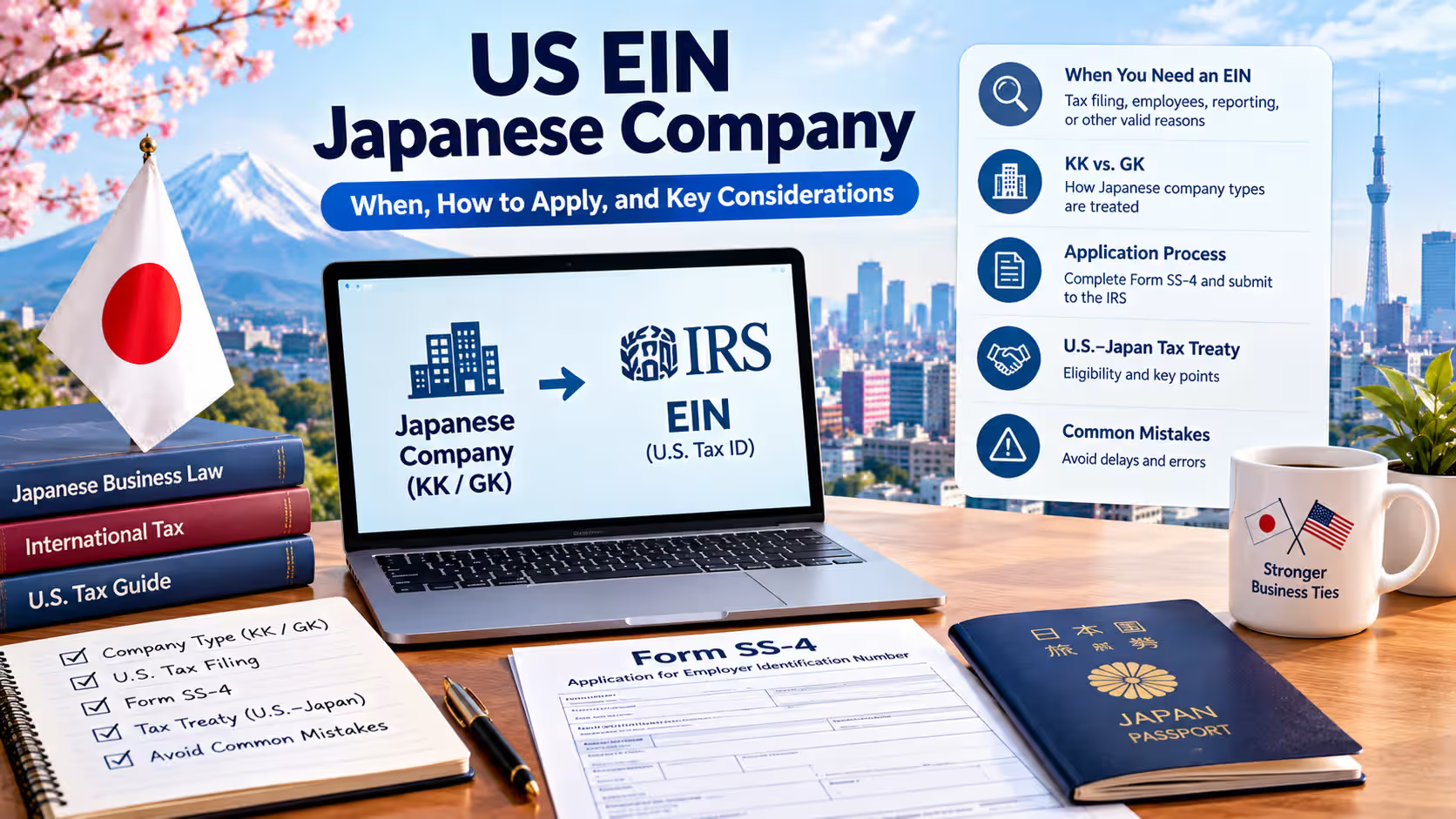
US EIN Japanese Company: How to Apply for a U.S. EIN
Yes. A Japanese company can apply for a U.S. Employer Identification Number (EIN) when it has a valid U.S. tax or reporting need. A us ein japanese company application does not always require forming a new U.S. company. Both Kabushiki Kaisha (KK) and Godo Kaisha (GK) businesses may qualify.
An EIN is a nine-digit number issued by the Internal Revenue Service (IRS). It identifies a business for U.S. federal tax purposes. A company may need one when it hires U.S. employees or has certain U.S. tax filing duties.
What Are Japanese KK and GK Companies?
Japan has several business structures. Two common types are Kabushiki Kaisha (KK) and Godo Kaisha (GK).
- Kabushiki Kaisha (KK): A KK is a stock company. It has shareholders and is often compared with a corporation.
- Godo Kaisha (GK): A GK is a limited liability company with members. Its management structure is generally more flexible.
These Japanese legal forms do not automatically determine how the IRS classifies the company for U.S. tax purposes. The correct treatment depends on the entity's legal features and applicable tax rules.
Japanese Company EIN: Requirements for KK and GK Businesses
A Japanese company EIN is a U.S. tax identification number issued by the IRS to an eligible business. An EIN for Japanese company applications may be needed when a business has U.S. tax, employee, or reporting responsibilities.
Whether your business needs a Japan business EIN depends on its U.S. activities. A Japanese KK may need a Japanese KK EIN when it has a valid reason to register for U.S. federal tax purposes. Japanese GK companies may also apply when they meet IRS requirements.
How to Get a US EIN for a Japanese Company
Getting a us ein japanese company application ready starts with checking the company's U.S. tax or reporting requirements. A Japanese KK or GK can apply when it has a valid reason to obtain an EIN.
1. Prepare the company information
Collect the company's legal name, Japanese business address, formation details, business activity, and responsible party information. Keep the details consistent with the company's official records.
2. Complete IRS Form SS-4
Form SS-4 asks for information about the business and the reason it needs an EIN. The responsible party must be an individual who owns, controls, or exercises effective control over the business.
If the responsible party does not have, and is not eligible to obtain, an SSN or ITIN, follow the IRS instructions for completing line 7b.
3. Submit the application to the IRS
Japanese businesses with their principal place of business outside the United States generally cannot use the IRS online EIN application. International applicants can review the available phone, fax, or mail options.
Check the latest official guidance before applying:
What Information Should a Japanese Company Prepare?
Before submitting an application, prepare the following details:
- The company's legal name in English, if available, and its Japanese legal name.
- Its registered business address in Japan.
- Company formation or registration details.
- A short description of its business activity.
- The name and details of the responsible party.
- The reason the company needs a U.S. EIN.
- Details of any U.S. office, employees, or business operations, where applicable.
The IRS may request additional information depending on the application. Accurate details can help prevent delays and processing issues.
Can a Japanese KK or GK Get a U.S. EIN Without a U.S. Subsidiary?
Yes, in some situations. A Japanese company may need an EIN because of its U.S. tax or reporting responsibilities, even if it has not formed a U.S. subsidiary.
Common expansion structures include:
- Direct operations: The Japanese company conducts business in the United States directly.
- U.S. subsidiary: The Japanese parent company forms a separate U.S. company.
- U.S. branch: The Japanese company operates through a branch in the United States.
Each structure can have different tax, registration, and reporting consequences. An EIN alone does not create a U.S. subsidiary or decide whether the company has a taxable presence in the United States.
Does the U.S.–Japan Tax Treaty Apply?
The United States and Japan have an income tax treaty. Depending on the company's circumstances, the treaty may affect how certain business income and other payments are taxed.
The treaty's business profits rules generally address when profits of a Japanese enterprise may be taxed in the United States. This can depend on whether the enterprise has a permanent establishment there.
Having an EIN does not automatically establish a permanent establishment or guarantee treaty benefits. Companies should review the treaty and seek professional tax advice before relying on a particular tax position.
Official source: IRS list of U.S. income tax treaties.
Common Mistakes to Avoid When Applying for a U.S. EIN
- Using a company name that does not match official registration documents.
- Entering incomplete or inconsistent details on Form SS-4.
- Listing a company instead of an individual as the responsible party.
- Using the online application when the business is not eligible.
- Choosing a U.S. tax classification without checking the entity's legal features.
- Assuming that an EIN automatically settles U.S. tax or treaty obligations.
Related EIN Guides for International Businesses
If your Japanese company is expanding into the United States, these guides may also help:
- How to Get an EIN for a U.S. LLC as a Non-U.S. Resident — learn about the application process for applicants outside the United States.
- EIN for Foreign-Owned LLCs — understand EIN requirements for U.S. LLCs owned by foreign individuals or companies.
Frequently Asked Questions
Can a Japanese KK apply for a U.S. EIN?
Yes. A Japanese KK may apply if it has a valid U.S. tax or reporting reason for an EIN. The IRS will review the information provided on Form SS-4.
Can a Japanese GK get an EIN without forming a U.S. LLC?
In some cases, yes. A Japanese GK may apply directly if it has a qualifying U.S. tax or reporting need. It does not always need to create a separate U.S. LLC.
Can a Japanese company apply without a U.S. Social Security Number?
Yes. The responsible party does not necessarily need an SSN or ITIN. The company should follow the current IRS instructions for completing line 7b of Form SS-4.
Does getting an EIN mean the company owes U.S. taxes?
No. An EIN is a tax identification number. Whether the company owes U.S. tax depends on its activities, income, legal structure, and applicable tax rules.
Final Thoughts
A Japanese KK or GK can apply for a U.S. EIN when it has a valid U.S. tax or reporting need. The main steps are to identify the correct applicant, prepare accurate company information, complete Form SS-4, and use an IRS application method available to international businesses.
Before expanding, review the company's U.S. structure and tax obligations with a qualified professional. This can help avoid filing mistakes and make the move into the U.S. market smoother.
This article provides general information, not legal or tax advice. IRS requirements and procedures can change. Check the latest official guidance before applying.