
7 Reasons the IRS Rejects SS-4 Forms from Non-U.S. Applicants
A rejected Form SS-4 can delay your U.S. LLC setup. Learn the application errors non-U.S. applicants should check, how to correct them, and when to contact the IRS.
- #EIN Application
- #Form SS-4
- #Non-resident EIN
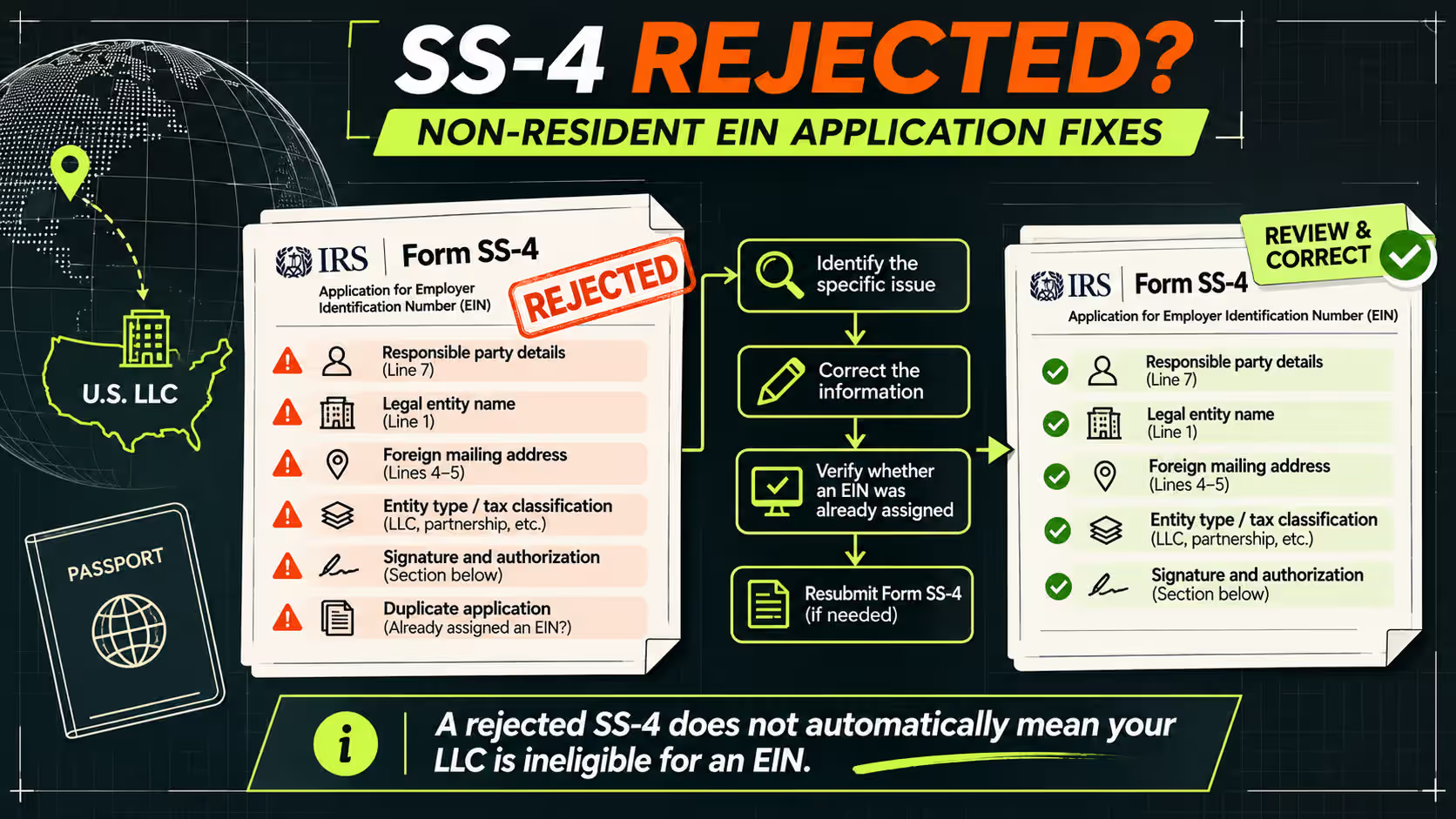

If you are dealing with an ss-4 rejected non resident application, identify the information or application detail the IRS could not process, correct it, and follow the instructions in the rejection notice. An ss-4 rejected non resident application does not automatically mean your U.S. LLC is ineligible for an EIN.
For foreign founders applying for an EIN for a U.S. LLC, even a small mistake can lead to a request for more information or a rejected application. These SS-4 application errors are among the key issues to review. Below are seven issues to check, ranked by practical troubleshooting priority. The IRS does not publish a frequency ranking for these errors, so this order should not be read as measured customer data.
Why the IRS rejects Form SS-4: 7 issues to check
1. The responsible party information is missing or incorrect
One of the most important parts of Form SS-4 is Line 7, which asks for the responsible party's name and taxpayer identification number. The responsible party must generally be an individual who ultimately owns or controls the entity. Listing the LLC itself, another company, or an unrelated service provider instead of the responsible individual can cause a problem.
For a foreign responsible party who does not have and is not eligible to obtain an SSN or ITIN, the IRS instructions say to enter “foreign” or “N/A” on Line 7b. The field still requires an entry. Do not leave it blank simply because the owner does not have a U.S. taxpayer identification number.
How to fix it: Confirm that Line 7a identifies the correct individual. If that person does not have and is ineligible to obtain an SSN or ITIN, enter “foreign” or “N/A” on Line 7b as directed by the current instructions. Do not enter a made-up number.
Illustrative example: A non-U.S. founder submits an SS-4 and leaves Line 7b empty because they do not have an SSN. The application is returned for the missing information. The correction is to complete the field using the IRS instruction for a foreign responsible party who is not eligible for an SSN or ITIN.
2. The legal name does not match the formation documents
Line 1 asks for the legal name of the entity applying for the EIN. The IRS instructs applicants to enter the name exactly as it appears on the applicable legal document. For an LLC, check the name against the filed formation document or certificate issued by the state.
Small differences can create uncertainty: missing words, an incorrect spelling, a different punctuation mark, or using a trade name instead of the LLC's legal name. A brand name or website name is not automatically the entity's legal name.
How to fix it: Compare Line 1 with the official formation document character by character. Put a trade name on Line 2 if applicable; do not substitute it for the legal entity name on Line 1.
Illustrative example: The state record says “Northstar Digital LLC,” but the SS-4 lists “Northstar Digital” on Line 1. Before resubmitting, the applicant checks the state document and uses the full legal name.
3. The applicant used the wrong EIN application method
Not every non-U.S. owner can use the IRS online EIN application. For an EIN application for non-residents, the available method depends on the applicant’s circumstances. The IRS says online applications are available when the applicant has a legal residence, principal place of business, or principal office or agency in the United States or a U.S. territory. If none of these applies, the online application cannot be used.
Eligible international applicants can apply by telephone, fax, or mail. The correct route depends on the applicant's circumstances and how quickly the EIN is needed. Sending the same application through several methods can also create duplicate-EIN problems.
How to fix it: Check the eligibility rules in the current Instructions for Form SS-4. If you have no qualifying U.S. residence, principal place of business, or principal office or agency, use one of the methods the IRS provides for international applicants. Use only one method for the entity.
4. The foreign address is incomplete or entered incorrectly
Foreign applicants sometimes enter an overseas mailing address using only the street and city, or abbreviate the country name. The IRS instructions require a foreign mailing address to include the city, province or state, postal code, and full country name. The country name should not be abbreviated.
Line 4 is the mailing address for IRS correspondence. Line 5 is the street address, if it is different. A P.O. box should not be entered as the physical street address on Line 5.
How to fix it: Review Lines 4a–4b and 5a–5b. Include all required address elements, spell out the country name, and make sure the mailing address is one where you can reliably receive IRS correspondence.
Illustrative example: An applicant enters “Bengaluru, IN” without the postal code or full country name. The applicant should revise the foreign address so the city, state or province, postal code, and country are clearly provided.
5. The entity type or tax classification is unclear
Form SS-4 asks what type of entity is applying and what kind of federal tax return it expects to file, if applicable. Selecting an entity type that does not match the LLC's actual structure, or leaving required details unclear, can make it difficult for the IRS to establish the correct business tax account.
An LLC's state-law status and its federal tax classification are not always the same thing. For example, a single-member LLC may generally be treated as a disregarded entity for federal income tax purposes unless it elects otherwise. A multi-member LLC is generally treated as a partnership unless it elects corporate treatment.
How to fix it: Review Line 9a and the relevant instructions carefully. Describe the entity accurately and do not select a tax classification simply because it sounds familiar. If you are unsure how the LLC is classified for federal tax purposes, ask a qualified U.S. tax professional before submitting a corrected form.
6. The form is incomplete, illegible, or not properly signed
An application can be delayed or returned if required information is missing, handwriting cannot be read, or the form is not signed by someone authorized to do so. The IRS says it cannot issue an EIN unless the applicant provides the information requested that applies to the entity.
For a foreign applicant, the person signing Form SS-4 may be a duly authorized person. The signature requirements depend on the entity type and the person's authority. If a third-party designee is being authorized to discuss the application and receive the EIN, the relevant designee section and signature authorization must be completed correctly.
How to fix it: Use the current IRS fillable Form SS-4, check every applicable line, make sure the information is legible, and confirm that the correct person has signed and dated the form. Complete the Third Party Designee section only if you want to grant that authority.
7. The application creates a duplicate or conflicts with an earlier EIN record
Some applicants submit another SS-4 because they did not receive a response to the first one. Others apply online after faxing, or ask a service provider to submit a second application without confirming whether the first was received. The IRS instructs applicants to file only one Form SS-4 and use only one application method for each entity to avoid receiving more than one EIN.
If the LLC already has an EIN, a second application may create confusion rather than solve the problem. The IRS also limits EIN issuance to one per responsible party per day across application methods.
How to fix it: Before submitting another SS-4, check the original fax or application confirmation and contact the IRS to ask whether an EIN was assigned. If you believe the LLC has received more than one EIN, explain that clearly and ask the IRS which number the entity should use.
What to do about an ss-4 rejected non resident application
If your SS-4 is rejected as a non-resident, do not immediately send the same form again. First, identify the reason for the rejection or request for additional information. If the IRS sent a letter or notice, read it carefully and follow the instructions it gives. If the reason is unclear, contact the IRS before preparing another submission.
- Keep the rejection notice. Save the complete letter, including any reference details and instructions.
- Compare the notice with your SS-4. Review the line or information the IRS identified.
- Check the current instructions. Use the latest IRS Instructions for Form SS-4, not an old saved copy.
- Correct only what needs correcting. Recheck the full form so the correction does not introduce another inconsistency.
- Confirm whether an EIN was already assigned. Do this before sending another application.
- Keep a complete record. Save the corrected form, fax confirmation, correspondence, and dates.
How international applicants can contact the IRS
The IRS lists +1 267-941-1099 as the telephone number for international EIN applicants who have no legal residence, principal place of business, or principal office or agency in the United States or its territories. The listed hours are Monday through Friday, 6:00 a.m. to 11:00 p.m. Eastern Time. It is not a toll-free number.
If you are calling about a rejected application, explain that you are a non-U.S. applicant, that you already submitted Form SS-4, and that you need to understand what must be corrected. Have the LLC's legal name, responsible-party details, application date, and rejection notice available. The IRS may direct you to the appropriate process based on the issue.
For fax applications, the current IRS instructions list 304-707-9471 for applicants faxing from outside the United States and 855-215-1627 for international applicants faxing from within the United States. Verify the numbers in the latest instructions before sending a form because IRS fax numbers may change.
Related EIN guides
If your application was rejected after a long wait or you are unsure whether the IRS received it, read our EIN delay help guide. If you are applying from outside the United States, see our step-by-step guide on how to fax Form SS-4 from outside the U.S..
Frequently asked questions
Can a non-U.S. resident get an EIN without an SSN or ITIN?
Yes. The IRS instructions say that if the responsible party does not have and is ineligible to obtain an SSN or ITIN, the applicant should enter “foreign” or “N/A” on Line 7b. An entry is still required.
Why was my SS-4 rejected even though my LLC is registered in the United States?
State registration does not guarantee that an EIN application is complete. The IRS may need accurate entity, responsible-party, address, classification, and signature information to establish the tax account.
Can I apply for an EIN online if I live outside the United States?
If you have no legal residence, principal place of business, or principal office or agency in the United States or its territories, the IRS says you cannot use the online EIN application. International applicants may use the telephone, fax, or mail methods described in the current instructions.
Should I submit another Form SS-4 after a rejection?
Follow the instructions in the IRS rejection notice first. Correct the identified issue and check whether an EIN was already assigned. Do not send duplicate applications through multiple methods.
What if I do not understand the IRS rejection notice?
Keep the notice and contact the IRS using the appropriate number or process. Explain that you are an international applicant with an ss-4 rejected non resident application and ask which information needs correction. If the issue involves federal tax classification, consider consulting a qualified U.S. tax professional.
Final takeaway
An SS-4 rejection does not necessarily mean a foreign-owned U.S. LLC cannot receive an EIN. Often, the next step is to identify what information is missing, inconsistent, or entered incorrectly. Review the responsible party, legal name, address, entity classification, signature, and application history before trying again.
Do not submit another Form SS-4 blindly. Use the IRS rejection notice and current instructions to correct the issue, and confirm whether an EIN has already been assigned. A careful correction is safer than creating another application problem.
Official IRS references
- Instructions for Form SS-4
- About Form SS-4
- IRS Internal Revenue Manual: Assigning Employer Identification Numbers
- Employer Identification Number (EIN)
Editorial note: The seven issues are ranked by practical troubleshooting priority, not by measured EINNumber.io customer frequency. The examples are illustrative scenarios based on the form requirements, not actual customer cases. No customer identities, case outcomes, or rejection statistics are claimed.