
What "Foreign" on SS-4 Line 7b Means and When It Causes Problems
Not sure what to enter on Form SS-4 Line 7b as a foreign business owner? Learn when to use “foreign” or “N/A,” what mistakes to avoid, and how to identify the correct responsible party
- #EIN
- #ss-4 line
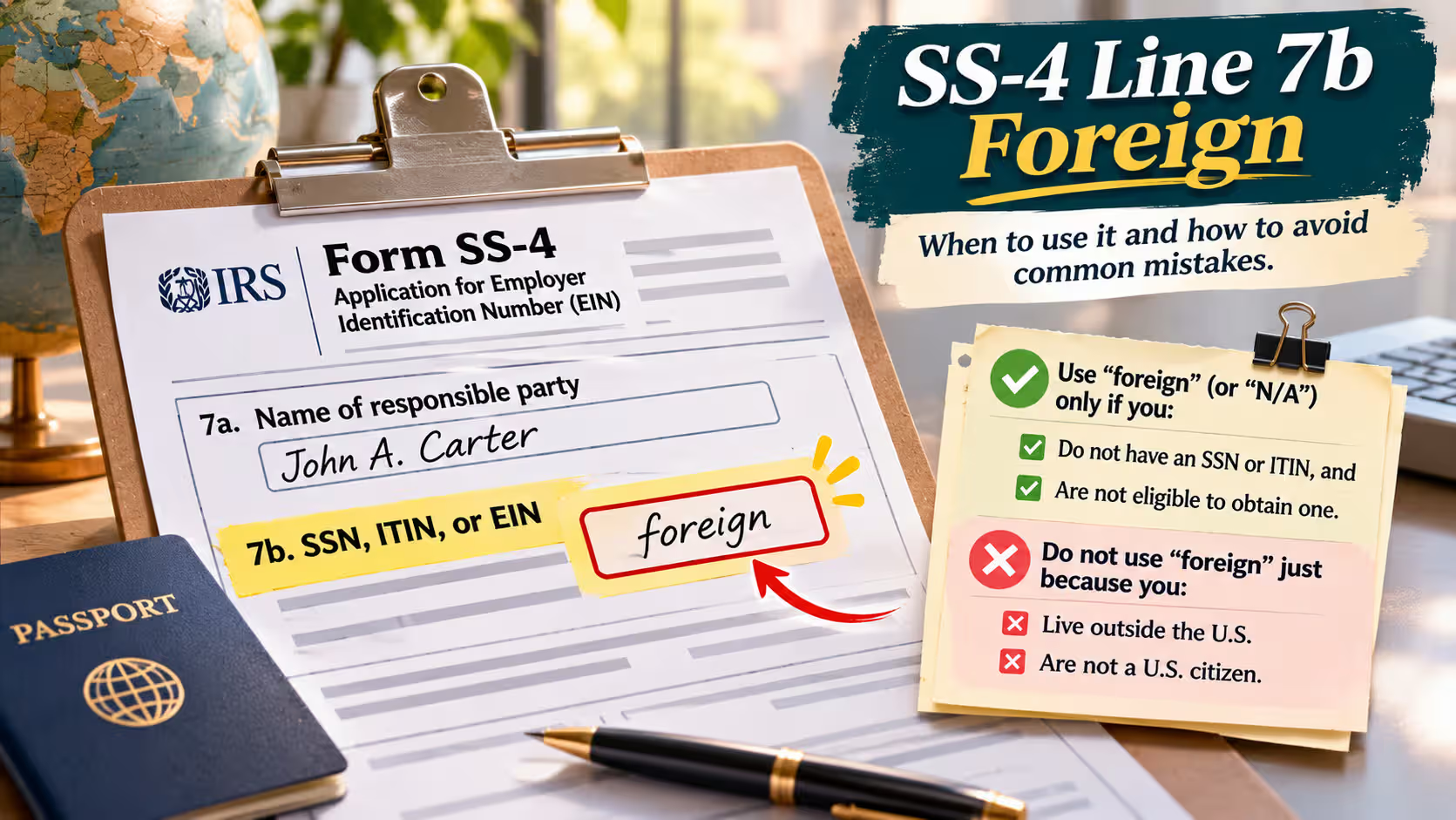
If you are completing Form SS-4 for a foreign-owned U.S. business, SS-4 Line 7b foreign is an entry the IRS allows in a specific situation: the responsible party does not have, and is not eligible to obtain, an SSN or ITIN. It is not a general label for every non-U.S. owner.
SS-4 Line 7b Foreign: What Does “Foreign” Mean?
Line 7b asks for the responsible party’s Social Security Number (SSN), Individual Taxpayer Identification Number (ITIN), or other applicable taxpayer identification number. The current IRS Instructions for Form SS-4 say to enter “foreign” or “N/A” on Line 7b if the responsible party does not have and is ineligible to obtain an SSN or ITIN. An entry is required.
In simple terms, “foreign” tells the IRS that the responsible party is a foreign individual who does not have, and is not eligible to obtain, the U.S. individual tax identification number requested on that line. It does not mean that the LLC itself is foreign, and it does not replace the responsible party’s name on Line 7a.
Who is the responsible party on Form SS-4?
The responsible party is the individual who ultimately owns or controls the entity, or exercises ultimate effective control over it. The IRS generally requires an individual—not another company—to be listed as the responsible party, except for certain government entities.
For a single-member LLC, the responsible party is often the individual owner if that person has ultimate control. For a multi-member LLC or corporation, identify the individual who actually has ultimate control under the IRS definition. Do not automatically enter the registered agent, formation company, nominee, or person who simply prepared the application.
When should you enter “foreign” on SS-4 Line 7b?
Use “foreign” or “N/A” when both of these conditions apply:
- The responsible party does not have an SSN or ITIN; and
- The responsible party is not eligible to obtain an SSN or ITIN.
If the responsible party already has an SSN or ITIN, enter the applicable number instead. Do not write “foreign” simply because the owner lives outside the United States, is not a U.S. citizen, or has a foreign passport.
The IRS instructions also make clear that a foreign individual does not have to obtain an ITIN solely to receive an EIN. Eligibility for an SSN or ITIN is a separate question from whether the business can receive an EIN.
Correct SS-4 Line 7b entry: an example
The following is a simplified illustration of the relevant part of Form SS-4, not an official IRS screenshot. Use the current IRS form when preparing your application.
| Form field | Illustrative entry |
|---|---|
| Line 7a – Name of responsible party | Full legal name of the individual who ultimately owns or controls the entity |
| Line 7b – SSN, ITIN, or EIN | foreign |
When this example applies: the named responsible party does not have an SSN or ITIN and is ineligible to obtain one. If the person has an SSN or ITIN, enter that number instead of “foreign.”
Common SS-4 Line 7b mistakes that can cause problems
The examples below are common error patterns to check for when reviewing a draft Form SS-4. They are illustrative troubleshooting examples, not a count or ranking of documented EINNumber.io customer cases.
1. Writing “foreign” just because the owner lives abroad
Living outside the United States does not, by itself, establish that the responsible party is ineligible for an SSN or ITIN. First determine whether the person has one or is eligible to obtain one. If an applicable number already exists, use it.
2. Leaving Line 7b blank
The current instructions say an entry is required. If the responsible party does not have and is ineligible to obtain an SSN or ITIN, enter “foreign” or “N/A” rather than leaving the field empty.
If you are still preparing your application, see our guide to EIN responsible party rules for foreign owners for help identifying the correct individual before you submit Form SS-4.
3. Putting “foreign” on Line 7a instead of Line 7b
Line 7a asks for the responsible party’s name. “Foreign” or “N/A” belongs in the identification-number field on Line 7b when the IRS condition applies. Enter the individual’s full name on Line 7a.
4. Listing the LLC or another company as the responsible party
For most applicants, the responsible party must be a natural person. Do not enter the LLC’s name or its EIN as the responsible party on Line 7a or 7b. Government entities have a specific exception in the IRS instructions.
5. Naming the wrong individual
Do not automatically list the organizer, registered agent, accountant, or application preparer. The responsible party should be the individual who ultimately owns or controls the entity, as defined by the IRS.
6. Entering a made-up or borrowed identification number
Never use another person’s SSN or ITIN, invent a number, or put the company’s EIN in the individual responsible party’s field. If the responsible party does not have and is ineligible to obtain an SSN or ITIN, follow the IRS instruction to enter “foreign” or “N/A.”
Does entering “foreign” on Line 7b cause an EIN rejection?
Not when it is used in the situation described by the IRS instructions. The entry is specifically allowed for a responsible party who does not have and is ineligible to obtain an SSN or ITIN. Problems can arise when the field is left blank, the wrong person is named, the applicant uses an incorrect identification number, or the entry does not match the responsible party’s actual circumstances.
Line 7b is only one part of Form SS-4. Check the legal entity name, mailing address, responsible party name, entity type, reason for applying, and signature or third-party designee details as well.
How to check Line 7b before submitting Form SS-4
- Identify the real responsible party. Apply the IRS definition of the individual who ultimately owns or controls the entity.
- Enter the individual’s full name on Line 7a. Check spelling against the person’s identity documents and the information used in the application.
- Check SSN or ITIN status. If the responsible party has an applicable number, enter it accurately.
- Use “foreign” or “N/A” only when appropriate. This means the person has no SSN or ITIN and is ineligible to obtain one.
- Review the current IRS instructions. Form instructions can change, so use the version applicable when you submit the application.
- Keep a copy of the completed form. Save the exact version submitted and any fax confirmation or IRS correspondence.
Frequently asked questions
Can a non-U.S. citizen write “foreign” on Line 7b?
Only if the responsible party does not have and is ineligible to obtain an SSN or ITIN. Citizenship or residence outside the United States alone is not enough to decide what belongs in Line 7b.
Can I get an EIN without an ITIN?
Yes. A foreign responsible party does not have to obtain an ITIN solely to receive an EIN. If the person does not have and is ineligible to obtain an SSN or ITIN, the IRS instructions allow “foreign” or “N/A” on Line 7b.
Should I enter “foreign” or “N/A”?
The current IRS instructions allow either entry when the responsible party does not have and is ineligible to obtain an SSN or ITIN. Use one clear entry; do not leave the field blank.
Can I put my LLC’s EIN on Line 7b?
Generally, no. The responsible party is usually an individual, not the LLC or another entity. The IRS provides a limited exception for government entities.
What if I already submitted Form SS-4 with Line 7b blank?
Do not automatically submit another application. Review the application status and any IRS notice first. If the IRS requests correction or additional information, follow the instructions in that communication. If you are unsure, contact the IRS using its current international EIN contact procedure.
Final thoughts
The key to SS-4 Line 7b foreign is understanding the condition behind the entry. It is not a shortcut for every foreign owner. Use “foreign” or “N/A” only when the responsible party has no SSN or ITIN and is ineligible to obtain one. Make sure the correct individual is named on Line 7a and review the current IRS instructions before submitting Form SS-4.
EINNumber.io is a private service that assists with EIN applications and related administrative steps. It is not the IRS or a government agency. The IRS does not charge a fee to issue an EIN directly.