
Your LLC Added or Removed a Member: Do You Need a New EIN?
Your LLC added or removed a member? Learn how ownership changes affect federal tax classification, when a partnership may end, and whether your LLC needs a new EIN.
- #EIN
- #llc
- #usllc
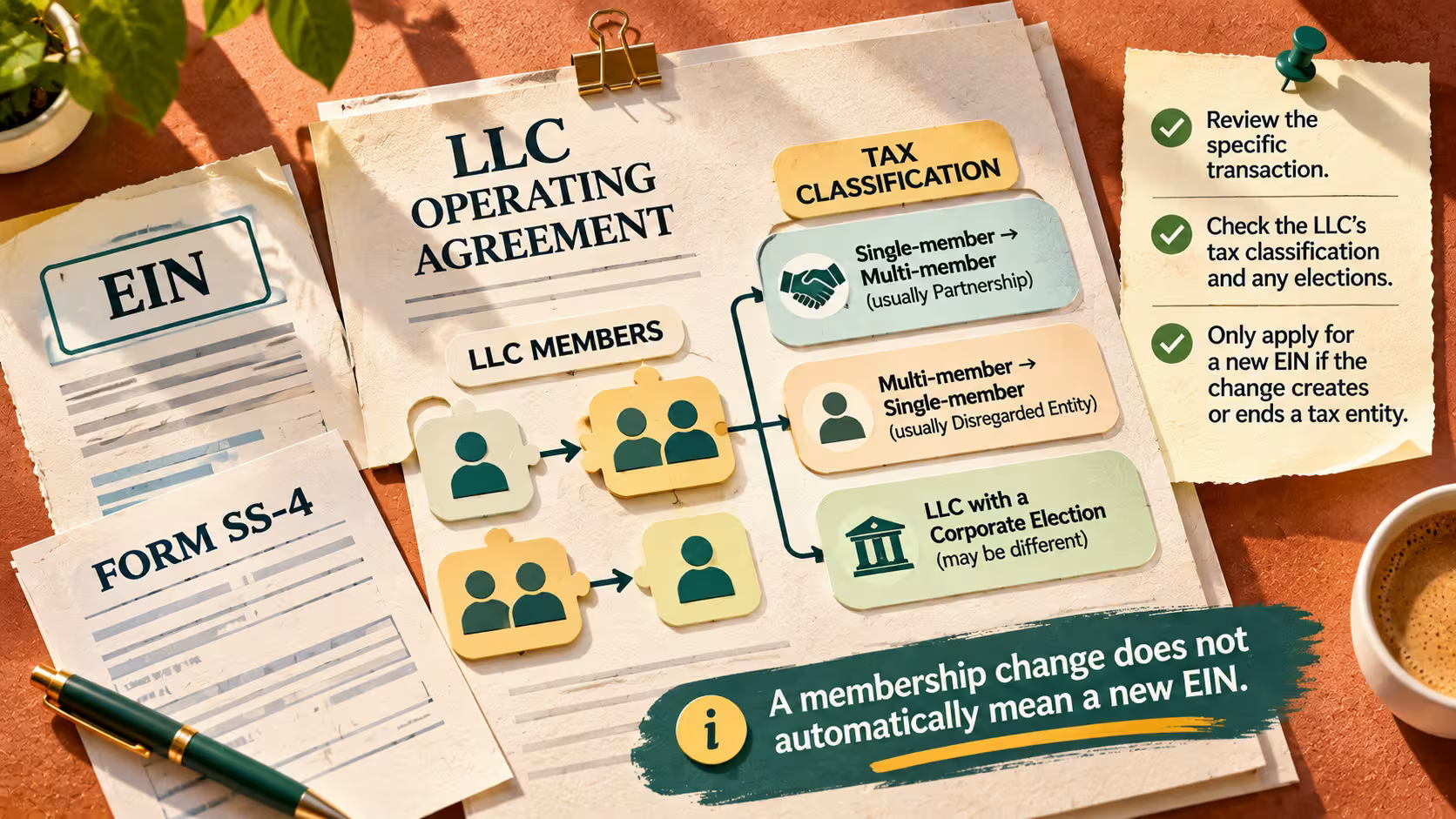
If your LLC added or removed a member, you may be wondering whether you need a new EIN when LLC members change. The answer depends on what changed: the LLC’s legal existence, its federal tax classification, and whether a partnership ended. A membership change alone does not give every LLC the same EIN answer.
This guide explains the common single-member and multi-member changes, how they affect federal tax classification, and what international LLC owners should check before applying for another EIN.
New EIN when LLC members change: the quick answer
Not automatically. The answer to whether you need a new EIN when LLC members change depends on whether the ownership transaction creates or ends a tax entity. The IRS generally requires a new EIN when an entity’s ownership or structure changes in a way that creates a different entity. But an LLC can continue as the same state-law entity while its default federal tax classification changes because the number of members changed.
The IRS says a domestic LLC with one member is generally treated as a disregarded entity for federal income tax purposes, while a domestic LLC with two or more members is generally treated as a partnership unless it elects corporate tax treatment. The IRS also explains that adding a member to a disregarded single-member LLC generally changes its default classification to a partnership, and reducing a partnership LLC to one member generally changes its default classification to a disregarded entity.
Those classification rules are important, but they do not mean you should automatically apply for a second EIN every time an owner joins or leaves. Review the exact transaction and the LLC’s existing EIN history before taking action.
Why the number of LLC members affects federal tax treatment
An LLC is created under state law. For federal tax purposes, however, the IRS classifies it based on the number of members and any tax elections that are in effect.
- Single-member LLC: By default, a domestic LLC with one owner is treated as a disregarded entity for federal income tax purposes. If the owner is an individual, the LLC’s business income is generally reported on the owner’s tax return.
- Multi-member LLC: By default, a domestic LLC with two or more owners is treated as a partnership for federal income tax purposes. It generally files Form 1065 and issues Schedule K-1s to its members.
- LLC taxed as a corporation: An LLC may elect corporate tax treatment. If a valid corporate election is already in effect when membership changes, the default partnership or disregarded-entity rules may not apply in the usual way.
The key point is that the state-law LLC and its federal tax classification are related but not identical. A change in the number of members can change the federal tax treatment even if the LLC continues under the same state registration.
Scenario 1: Your single-member LLC adds a new member
Suppose you formed a U.S. LLC as its only owner. It was treated as a disregarded entity for federal income tax purposes. Later, another person or business acquires an ownership interest and the LLC now has two members.
Under the IRS default-classification rules, a single-member LLC that acquires an additional member generally becomes a partnership for federal income tax purposes. This can happen when the new member buys part of the original owner’s interest or contributes money or property to the LLC in exchange for an ownership interest.
What changes for tax filing?
If the LLC is now classified as a partnership and no corporate election applies, it generally has a Form 1065 partnership filing obligation. The members generally receive Schedule K-1s reporting their shares of partnership income, deductions, and other tax items.
The transaction that brought in the new member can also have tax consequences. For example, a sale of part of the original owner’s interest is not necessarily treated the same as a new member contributing capital directly to the LLC. The IRS discusses these different transactions in Publication 3402. Do not assume that the change is tax-free simply because the LLC kept its name and state registration.
Does adding a member mean you must get a new EIN?
Do not make that decision from the member count alone. The IRS explains the change in default tax classification, and its general EIN guidance says a new EIN is needed in certain ownership or structure changes. However, the public EIN guidance does not say that every continuing LLC must obtain a new EIN solely because a member was added.
Check whether the LLC itself continues under state law, whether it already has an EIN, whether it had a corporate tax election, and whether the transaction created or terminated a tax entity. If the facts are not clear, confirm the EIN treatment with the IRS or a qualified U.S. tax professional before submitting Form SS-4. Avoid applying for another EIN just to reflect a new member.
Scenario 2: A multi-member LLC removes a member and becomes single-member
Now consider the reverse situation. Your LLC had two or more members and was treated as a partnership. One member sells or transfers their entire interest to the remaining owner. The LLC now has only one member.
Under the default federal tax classification rules, an LLC classified as a partnership generally becomes a disregarded entity when its membership is reduced to one member, unless a corporate election is in effect.
Publication 3402 explains that when one member acquires the other member’s entire interest, the partnership terminates for federal tax purposes. The continuing owner may be treated as acquiring the former partnership’s assets through deemed transactions. The exact tax consequences depend on the transaction and the assets involved.
What happens to the partnership tax return?
The partnership may have a final Form 1065 filing obligation for the period ending when the partnership terminates. The final return and related Schedule K-1 reporting should reflect the actual termination date and transaction. The remaining owner’s later reporting may follow the rules for a single-member disregarded LLC, unless the LLC has elected corporate treatment.
Does the remaining owner automatically keep the old EIN?
Do not assume that the old partnership EIN should continue to be used for every later filing. The IRS’s partnership EIN guidance says a new EIN is generally needed when one partner takes over and operates the business as a sole proprietorship, or when a partnership ends and a new one begins. At the same time, the LLC may continue as a state-law entity after the federal tax classification changes.
Because the legal LLC can continue while the partnership tax classification ends, the correct EIN treatment should be checked against the precise ownership transaction and the LLC’s existing EIN record. Ask the IRS or a qualified tax professional how to handle the EIN before filing under a different classification. Do not use a member’s personal SSN or ITIN as a replacement for the LLC’s EIN without confirming the reporting requirement for the specific tax form.
Scenario 3: One member leaves, but the LLC still has two or more members
If a three-member LLC loses one member and two owners remain, it generally stays a multi-member LLC for federal income tax purposes. If it was already classified as a partnership and no corporate election applies, it generally continues to be treated as a partnership.
The ownership percentages and profit-sharing arrangements may change, and the transfer or sale of the departing member’s interest may have tax consequences. But the LLC has not automatically become a single-member LLC, and the partnership has not necessarily ended simply because one member left.
The IRS says a partnership generally does not need a new EIN for a change in ownership that does not result in termination of the partnership. Keep the operating agreement, membership ledger, transfer documents, and tax records consistent with the actual change.
Scenario 4: Your LLC already elected to be taxed as a corporation
The default single-member and multi-member rules do not tell the whole story if the LLC has elected to be taxed as a corporation.
An LLC may elect to be classified as a C corporation by filing Form 8832. An eligible LLC may elect S corporation status by filing Form 2553. If an election is effective when a member joins or leaves, the LLC may remain classified as a corporation rather than automatically switching to partnership or disregarded-entity treatment.
However, changes in ownership can still affect whether the business remains eligible for a particular tax status. This is especially important for international owners: an S corporation generally cannot have a nonresident alien shareholder. If a new or remaining member is a nonresident alien, do not assume the LLC can keep or elect S corporation status. Review eligibility with a qualified tax professional before making the change.
A corporate tax election can also have consequences if the LLC later changes classification. The IRS explains that classification elections can trigger deemed transactions involving the LLC’s assets and liabilities. Do not file Form 8832 or Form 2553 simply to update the member list.
What international LLC owners should check before changing members
For founders who live outside the United States, a membership change can involve more than the EIN. Before updating tax records, check these points:
- Confirm the legal ownership change. Review the operating agreement, membership purchase or transfer agreement, contribution documents, and state filing requirements.
- Identify the effective date. The date the new member acquired an interest or the departing member transferred an interest can affect tax reporting.
- Confirm the federal tax classification. Establish whether the LLC was disregarded, treated as a partnership, or elected to be taxed as a corporation before the change.
- Check the existing EIN record. Find the EIN notice and prior federal tax filings. Do not request another EIN until you understand whether the existing number remains appropriate.
- Review partnership filing obligations. If the LLC becomes or ceases to be a partnership, determine whether a Form 1065, final return, or Schedule K-1 reporting is required.
- Review foreign-owner tax reporting. Foreign ownership can create additional U.S. reporting obligations. For example, a foreign-owned domestic disregarded entity may have Form 5472 filing requirements when reportable transactions occur.
- Update the responsible party if necessary. If the person who controls or manages the entity changes, review the IRS responsible-party rules and whether Form 8822-B must be filed. A member change does not automatically mean the responsible party changed.
Do not confuse an EIN change with an LLC ownership update
An EIN is a federal tax identification number. It does not replace the LLC’s operating agreement, state business registration, or ownership records.
Adding a member or removing a member may require updates to the operating agreement, state records, bank records, payment platforms, and tax filings. Those updates are separate from deciding whether the IRS requires a new EIN.
Likewise, changing the responsible party is not the same as changing the EIN. Read our EIN responsible party guide if the person who controls the business has changed.
What to do before applying for a new EIN
Before submitting Form SS-4 for another EIN, prepare a short record of the change:
- The LLC’s legal name and state of formation.
- The current EIN and the date it was assigned.
- The old and new member count.
- The date the ownership change took effect.
- Whether the change was a sale, transfer, contribution, or another transaction.
- The LLC’s prior and current federal tax classification.
- Any Forms 8832 or 2553 already filed and their effective dates.
- Whether the LLC continues as the same state-law entity.
Use these facts to confirm the EIN requirement with the IRS or a qualified U.S. tax professional. If a new EIN is required, apply using the current IRS Form SS-4 instructions. The IRS does not charge a fee to issue an EIN.
How EINNumber.io can help
EINNumber.io is a private EIN application assistance service, not the IRS, a law firm, or a tax preparation firm. The IRS issues EINs for free. A private service may charge for assistance with an EIN application, but it cannot decide complex partnership termination or tax-classification questions on behalf of the IRS.
If you have confirmed that your LLC needs a new EIN and want help preparing the application, you can review EINNumber.io’s current assistance options. If you are unsure whether the membership change requires a new EIN, first resolve the tax-classification question with the IRS or a qualified tax professional. This helps avoid unnecessary duplicate EIN applications.
Frequently asked questions
Do I need a new EIN when I add a member to my single-member LLC?
Adding a member generally changes a domestic single-member LLC’s default federal income tax classification from a disregarded entity to a partnership. That does not, by itself, establish that every continuing LLC must obtain a new EIN. Review the entity’s legal status, existing EIN, tax elections, and the transaction before applying again.
Does an LLC need a new EIN when one member leaves?
It depends on how many members remain and what happens to the partnership. If two or more members remain, the LLC generally remains a partnership under the default rules. If only one member remains, the LLC generally becomes a disregarded entity for federal income tax purposes unless a corporate election applies. Check the EIN treatment before changing the number used on tax filings.
Does a multi-member LLC automatically become a sole proprietorship when one member leaves?
For federal income tax purposes, an LLC that goes from multiple members to one member generally becomes a disregarded entity. If the remaining owner is an individual, its business income is generally reported as part of that owner’s tax return. The state-law LLC may continue to exist.
Does adding or removing a member change the LLC’s tax classification?
It can. A domestic LLC with one member is generally disregarded for federal income tax purposes, while an LLC with two or more members is generally treated as a partnership. A valid corporate tax election can change this default result.
What if my LLC elected to be taxed as an S corporation?
The default member-count rules may not apply while the corporate election is effective. However, S corporations have strict shareholder eligibility rules. A nonresident alien generally cannot be an S corporation shareholder, so international owners should review eligibility before a member change.
Can I keep the same EIN if the LLC name and state registration stay the same?
The same name and state registration do not settle the EIN question. The relevant facts include the legal entity, federal tax classification, ownership transaction, and whether a partnership or other entity ended. Confirm the EIN treatment rather than relying on the business name alone.
Should I submit Form SS-4 immediately after a member change?
No. First determine whether a new EIN is actually required. Applying for another EIN without checking the existing account can create duplicate-number and filing problems.
Final takeaway
When LLC members change, the federal tax classification may change even if the state-law LLC continues. Adding a member to a default single-member LLC generally creates partnership tax treatment; reducing a partnership LLC to one member generally creates disregarded-entity treatment. But neither situation should lead to an automatic new EIN application. Confirm the legal structure, tax election, partnership status, and existing EIN record before taking action.