
Japanese Names on Form SS-4: Name Order and Romanization
Japanese founders applying for a U.S. EIN need to enter their names carefully on Form SS-4. Learn how to handle family name order, given names, passport romanization, and responsible party details.
- #EIN Application
- #Form SS-4
- #Japanese Founders
- #Japanese Names
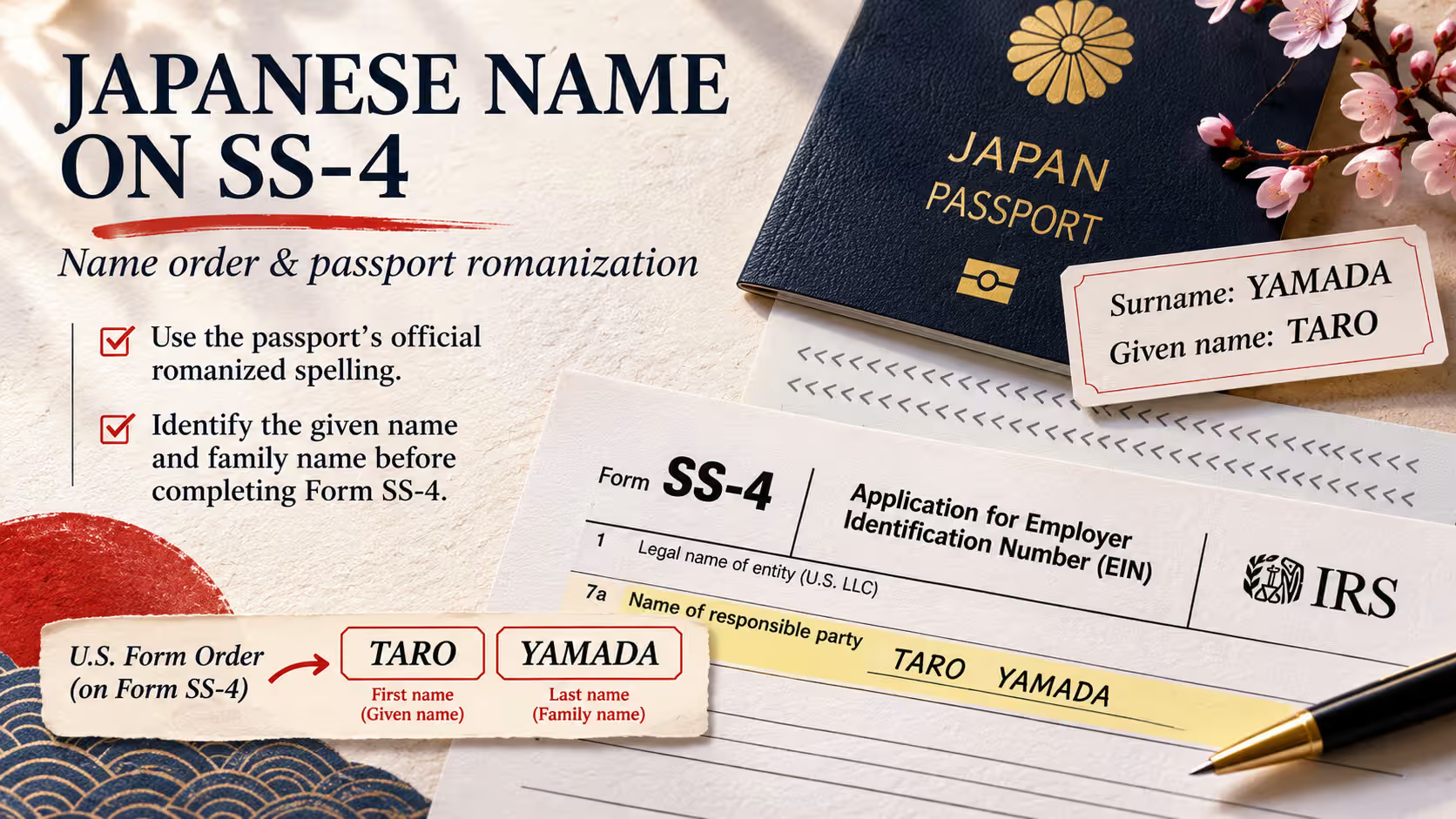
Japanese name SS-4 entries should use the applicant's correct legal name and consistent passport romanization. Japanese names commonly place the family name before the given name, while Form SS-4 requests an individual's name in first-name, middle-initial, and last-name order. Identify each name component from the passport before completing the form.
This guide explains how Japanese founders can handle family name order, passport romanization, middle names, and responsible party details when applying for a U.S. Employer Identification Number (EIN).
Japanese Name SS-4 Rules: What Japanese Founders Should Check
Japanese names can create confusion on U.S. forms because the usual Japanese name order differs from the name order commonly used on American forms.
For a Japanese founder, the important points are:
- Use the correct legal name of the U.S. LLC on Form SS-4 Line 1.
- Use the responsible party's full name on Line 7a.
- Check the surname and given name shown in the passport's personal details.
- Use the passport's romanized spelling rather than creating a new English spelling.
- Do not invent a middle name or rearrange name components without checking the document fields.
Japanese Family Name Order vs. U.S. Name Order
In Japanese, the family name generally comes before the given name. For example, a person named 山田太郎 is conventionally written with the family name first in Japanese contexts.
On Form SS-4, the IRS instructions describe an individual's name in first-name, middle-initial, and last-name order, if applicable. This means a Japanese founder should identify the family name and given name correctly before entering them in the order requested by the form.
Example: Japanese Name Order
Consider a fictional Japanese founder whose passport lists:
- Surname: YAMADA
- Given name: TARO
The passport's surname and given name fields identify the two parts of the person's legal name. When entering the responsible party's name on Form SS-4, follow the IRS first-name and last-name convention while preserving the exact spelling of those passport fields.
For this example, the name components would be understood as:
- First name: TARO
- Last name: YAMADA
Do not assume that the first word in a Japanese-style full name is the given name. Identify the family name and given name from the passport labels before completing the U.S. form.
How to Match Japanese Passport Romanization on Form SS-4
Passport romanization is important when entering a Japanese founder's name on a U.S. tax form. Use the romanized spelling shown on the passport rather than independently translating or changing the name.
Use the Passport's Surname and Given Name Fields
Check the personal details page of the passport. Identify the fields labeled surname and given name. Use those labels to determine which part of the name is the family name and which part is the given name.
The machine-readable zone (MRZ) at the bottom of the passport can also help you compare the name components. Check that the romanized spelling corresponds to the passport's personal details rather than relying only on the order in which the full name appears.
For example, a passport showing the surname YAMADA and given name TARO identifies the same two name components even though a U.S. form may ask for the given name first.
Do Not Create a Different Romanized Spelling
Use the spelling shown in the passport. Do not casually change it to another romanization simply because a different spelling may also be familiar or commonly used.
For example, do not change a passport spelling from “SHO” to “SHOU” or “TARO” to “TAROH” just to make the name look more familiar in English. Keep the spelling consistent with the person's official identification and relevant legal records.
The IRS does not provide a separate Japanese romanization system for Form SS-4. The practical approach is to preserve the person's legal name and use the passport spelling consistently when completing the application.
How to Enter a Japanese Name on Form SS-4
The correct entry depends on which person or entity the IRS is asking you to identify. The LLC's legal name and the responsible party's personal name belong in different fields.
Line 1: Legal Name of the LLC
Enter the U.S. LLC's full legal name as shown on its formation or registration documents. Do not enter the founder's personal name unless the applicant is an individual rather than the LLC.
Line 2: Trade Name, If Different
Enter a trade name only if the business uses a name different from its legal name. Do not use a shortened brand name in place of the LLC's legal name on Line 1.
Line 7a: Name of the Responsible Party
Enter the full name of the individual who ultimately owns or controls the LLC, or exercises ultimate effective control over it. The IRS instructions describe the name in first-name, middle-initial, and last-name order, if applicable.
For a Japanese founder, identify the surname and given name from the passport before entering them in the order requested by the form. Do not treat the family name as a middle name simply because it appears first in Japanese name order.
Line 7b: SSN, ITIN, or Other Permitted Entry
Enter the responsible party's SSN or ITIN when applicable. A foreign responsible party who has neither and is ineligible to obtain one may enter “Foreign” or “N/A” on Line 7b, as permitted by the IRS instructions.
A Japanese passport number, My Number, or other Japanese identifier does not replace a U.S. SSN or ITIN.
What If Your Japanese Passport Includes a Middle Name or Alternative Name?
Some founders may have additional name details or variations across passports, company records, and other legal documents. Do not automatically treat every additional name or variation as part of the primary legal name for an EIN application.
If your passport or other legal documents contain a genuine middle name, use it consistently where the form requests a middle initial. Do not invent a middle name simply to fill a field.
If your passport contains a name variation, or your company documents use a different romanized spelling, review the relevant legal records before submitting Form SS-4. Keep supporting documents available in case clarification is needed.
Common Japanese Name Mistakes on Form SS-4
| Common mistake | Better approach |
|---|---|
| Entering the family name first without checking the U.S. form's requested order | Identify the passport's surname and given name fields, then follow the SS-4 instructions. |
| Changing the passport's romanized spelling | Use the official spelling shown in the passport. |
| Inventing a middle name | Include a middle name or initial only when it is part of the person's actual name. |
| Using the founder's name on Line 1 instead of the LLC's legal name | Enter the entity's legal name on Line 1 and the responsible party's name on Line 7a. |
| Using a Japanese passport number or My Number as an SSN | Follow the IRS rules for Line 7b and use the permitted foreign designation when eligible. |
| Using different name spellings across application records | Check the passport, LLC records, and supporting documents before filing. |
Japanese Name SS-4 Checklist Before You Apply
Before submitting your EIN application, review these details:
- Confirm the LLC's legal name against its formation documents.
- Check the passport's surname and given name fields.
- Compare the romanized name with the machine-readable zone.
- Enter the responsible party's name in the order requested by Form SS-4.
- Do not add an unsupported middle name or alternative spelling.
- Check Line 7b against the IRS rules for foreign responsible parties.
- Review all name details before submitting the application.
For the current form and detailed line-by-line requirements, refer to the IRS Instructions for Form SS-4.
Get Help With Your EIN Application
Japanese founders applying for a U.S. EIN should take extra care when transferring their names from Japanese passports to U.S. tax forms. Correctly identifying the family name, given name, and official romanization can help prevent avoidable inconsistencies.
EINNumber.io's EIN application support service can help prepare and review application details. EINNumber.io is a private support service, not the IRS or a government agency. The IRS assigns EINs, and applying directly with the IRS is free. Service fees cover private application assistance, not the EIN itself.
Frequently Asked Questions
Should Japanese names be written family name first on Form SS-4?
Not automatically. Japanese names generally place the surname before the given name, but the IRS instructions describe an individual's name in first-name, middle-initial, and last-name order. Identify the name components from the passport and follow the form's requested order.
Should I use the romanized name or Japanese characters on Form SS-4?
Use the romanized name in the format accepted by the IRS form. Match the spelling shown on the passport and relevant legal records rather than creating a new transliteration.
Does the Japanese passport's MRZ show the family name first?
The machine-readable zone generally places the surname before the given name, separated by special filler characters. Use it to help identify the name components and compare them with the passport's labeled fields.
Can I use a different English spelling of my Japanese name?
Use the spelling shown on your official passport unless your legal name or official records have been changed. Avoid switching between romanization styles during the EIN application.
What if my Japanese passport shows an alternative or former surname?
Check the name details against your legal records. Do not automatically treat an alternative name as part of the primary legal name. If the difference affects your application, review the supporting documents before filing.
Can I apply for an EIN without a U.S. SSN?
Yes, a foreign responsible party may be able to apply without an SSN. If the person has neither an SSN nor an ITIN and is ineligible to obtain one, the IRS instructions allow “Foreign” or “N/A” on Line 7b in the relevant circumstances.