
Freelance Developers and Designers: Should You Form a U.S. LLC and Get an EIN?
Should freelance developers and designers living outside the United States form a U.S. LLC? Learn when an LLC and EIN can help, what they cost, and when a simpler business setup may be better.
- #Freelance Designers
- #Freelance Developers
- #Freelancers
- #U.S. LLC
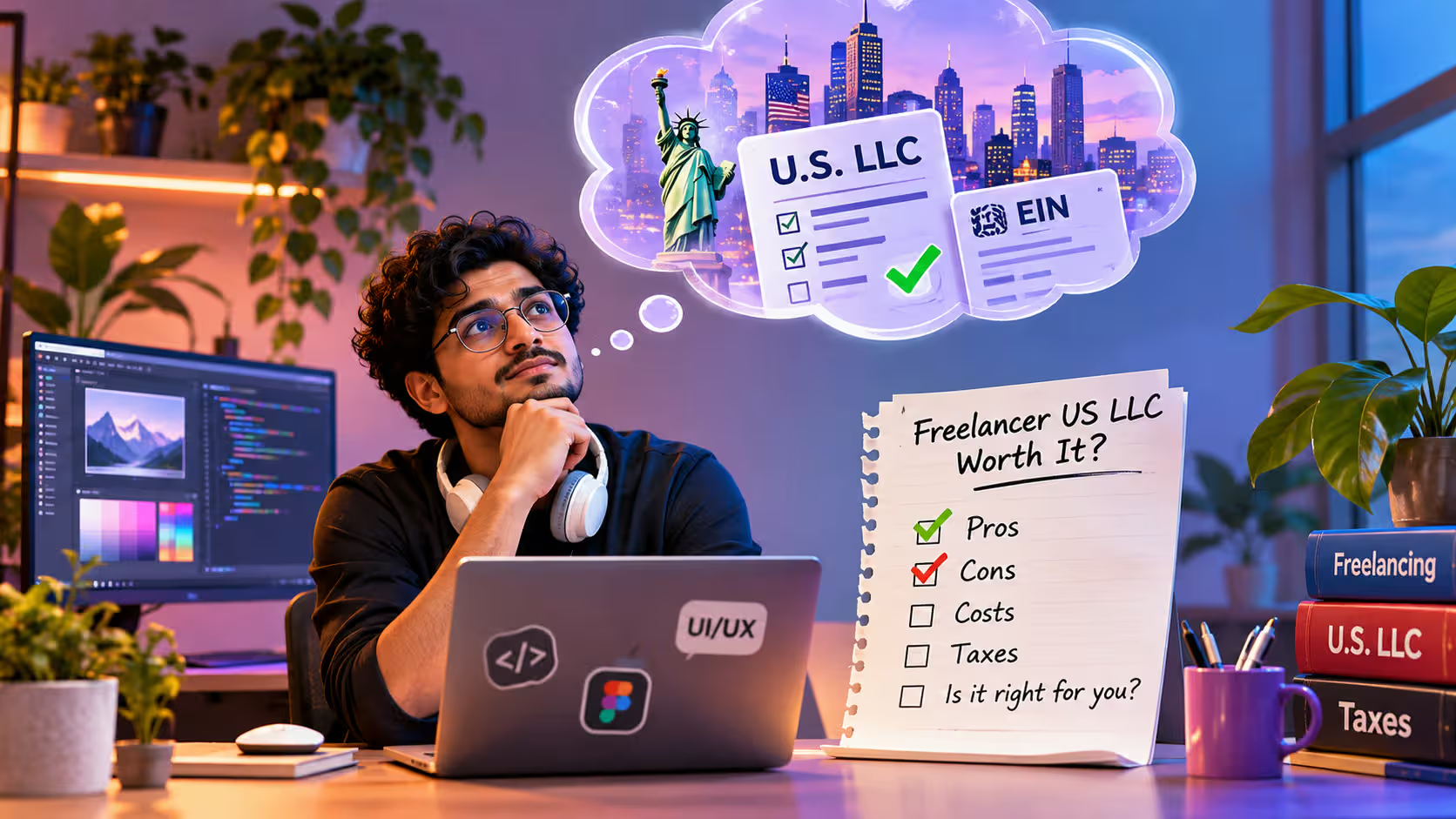
Is a freelancer us llc worth it for freelance developers and designers living abroad? It can be useful if you need a U.S. business structure for client contracts, banking applications, or business growth. But an LLC also brings setup costs, annual fees, and tax reporting duties. It is not the right choice for every freelancer.
What Is a U.S. LLC for Freelancers?
A Limited Liability Company (LLC) is a business structure created under U.S. state law. It separates the business from its owner for many legal and financial purposes.
Foreign residents can generally own a U.S. LLC. You do not always need to live in the United States or become a U.S. citizen to form one. However, state rules, business activities, banking requirements, and tax obligations still apply.
Many international freelancers consider an LLC because they work with U.S. clients, want a formal business structure, or plan to expand their services. But forming an LLC does not automatically make your business a U.S. tax resident or reduce your taxes.
Do Freelancers Need an EIN?
An Employer Identification Number (EIN) is a federal tax identification number issued by the Internal Revenue Service (IRS). It identifies a business for certain federal tax and administrative purposes.
An EIN may be useful for:
- Opening or applying for a business bank account.
- Completing certain business tax forms.
- Hiring employees.
- Meeting specific payment processor or client requirements.
- Filing required tax returns and information reports.
An EIN is not the same as an LLC registration. You form the LLC with a state and apply separately to the IRS for an EIN.
An EIN for foreign freelancers can help identify a U.S. business for certain tax, banking, and client onboarding requirements. However, getting an EIN does not automatically provide a U.S. bank account or reduce your tax obligations.
Some single-member LLCs may not need an EIN for every federal tax purpose if they have no employees or relevant excise tax obligations. However, a foreign-owned single-member LLC may need an EIN for certain reporting requirements, including Form 5472 when applicable.
Read the IRS guide to Employer Identification Numbers for official information.
Benefits of a U.S. LLC for Freelance Developers and Designers
1. A Formal Business Structure
A U.S. LLC gives your freelance business a registered legal structure. You can use the LLC's legal name in contracts, invoices, and business records.
This may help when working with companies that prefer to contract with registered businesses rather than individuals.
2. Business Banking Applications
Some financial service providers accept applications from U.S. LLCs with non-U.S. owners. An EIN may be one of the documents requested during the application process.
However, approval is not guaranteed. Providers can ask for identity documents, business information, ownership details, and a qualifying business address.
3. Working With U.S. Clients
Some U.S. clients may prefer to work with a registered U.S. company. An LLC can provide a formal business identity for proposals, service agreements, and invoices.
It does not guarantee more clients or higher rates. Your skills, portfolio, communication, and service quality remain important.
4. Preparing for Business Growth
If you plan to hire developers, designers, virtual assistants, or other contractors, an LLC may provide a structure for managing a growing business.
It can also make business records and financial activities easier to organize. You must still follow applicable employment, contractor, and tax rules.
Disadvantages of Forming a U.S. LLC
1. Formation and Annual Costs
Forming an LLC involves state filing fees. Some states also charge annual report fees, franchise taxes, or other recurring costs.
You may also need to pay for a registered agent, accounting support, tax preparation, and business compliance services.
These costs can be significant if you earn a small or irregular freelance income.
2. Tax Reporting Responsibilities
A U.S. LLC does not remove your tax responsibilities. Your reporting requirements depend on the LLC's tax classification, ownership, business activity, and other facts.
A foreign-owned single-member LLC that is treated as a disregarded entity may need to file Form 5472 with a pro forma Form 1120 when it has reportable transactions with its foreign owner or other related parties.
Missing a required information return can lead to serious penalties. Review the IRS Form 5472 instructions and get professional advice if you are unsure about your filing duties.
3. Home-Country Tax Obligations
Living outside the United States does not mean you can ignore the tax rules of your country of residence.
Your home country may tax your worldwide income, require foreign business disclosures, or have rules about controlled foreign companies. You should check these requirements before forming a U.S. LLC.
4. Banking and Payment Approval Is Not Guaranteed
Having an LLC and EIN does not guarantee approval from a U.S. bank, fintech company, payment processor, or marketplace.
Each provider has its own eligibility rules. Some may require a U.S. business address, proof of business activity, identity checks, or additional documents from non-U.S. owners.
Is a Freelancer US LLC Worth It?
The answer depends on your clients, income, business plans, and current business structure. A U.S. LLC may be useful for some freelancers, but it can be unnecessary for others.
When a U.S. LLC May Be Worth It
- You regularly work with U.S. companies that prefer U.S. business entities.
- You need a formal company structure for business contracts.
- You plan to hire contractors or build a larger agency.
- You have a clear business reason for applying for U.S. banking or payment services.
- Your expected business income can justify the formation and ongoing costs.
A U.S. LLC for freelance designers may be useful when clients prefer working with a registered U.S. company, or when a designer plans to hire a team and build a larger creative business. If you work alone and already serve clients without a U.S. entity, the extra costs may not be worthwhile.
When a U.S. LLC May Not Be Worth It
- You have only a few clients and earn a low or irregular income.
- Your clients are comfortable paying you as an individual freelancer.
- You do not need a U.S. business entity for banking or contracts.
- Your home-country business structure already meets your needs.
- You want an LLC only because you believe it will automatically reduce taxes.
If you do not have a clear business reason, it may be better to continue operating under your current legal structure and review the decision when your business grows.
U.S. LLC vs. Working as an Individual Freelancer
| Factor | Individual Freelancer | U.S. LLC |
|---|---|---|
| Setup | Usually simpler | Requires state registration |
| Ongoing costs | May be lower | State and compliance costs may apply |
| Business identity | Uses individual identity or local business name | Can use registered LLC name |
| Business banking | Depends on provider and country | May qualify for some U.S. business accounts |
| Tax reporting | Depends on local and applicable tax rules | May involve additional U.S. reporting |
| Liability separation | Generally no separate LLC entity | May provide liability protection, subject to legal limits |
The right structure depends on your circumstances. An LLC is not automatically better than operating as an individual freelancer.
Tax Forms Freelancers Should Understand
Foreign freelancers with U.S. clients or a U.S. LLC may encounter different IRS tax forms. The correct form depends on who earns the income, the business's tax classification, and the nature of the payment.
Form W-8BEN
Form W-8BEN is generally used by a foreign individual to certify foreign status and, where applicable, claim treaty benefits. A foreign individual who owns a single-member U.S. LLC treated as a disregarded entity may need to provide owner-level documentation when the individual is the beneficial owner.
See the IRS instructions for Form W-8BEN.
Form W-8BEN-E
Form W-8BEN-E is generally used by foreign entities to certify their status for U.S. withholding tax purposes. It is not automatically the correct form simply because a foreign person owns a U.S. LLC.
See the IRS instructions for Form W-8BEN-E.
Form W-9
Form W-9 is generally used by U.S. persons to provide their taxpayer identification number. A single-member LLC that is disregarded for federal tax purposes generally provides the owner's tax information rather than treating the LLC as a separate taxpayer for this purpose.
See the IRS instructions for Form W-9.
Where Is Freelance Income Sourced?
For many personal services, the source of income generally depends on where the work is physically performed. It does not automatically depend on where your client is located or which currency you receive.
For example, a developer living abroad and performing all services outside the United States may generally have foreign-source service income, even when the client is a U.S. company. Work performed partly inside and partly outside the United States may require allocation.
Read the IRS guidance on the source of personal service income.
How Much Does a U.S. LLC Cost?
The cost depends on the state where you form the LLC and the services you use. Common expenses include:
- State filing fee: The amount varies by state.
- Registered agent: A recurring fee may apply if you hire a service.
- Annual report or state fee: Some states require recurring payments.
- Tax preparation: You may need professional help with federal reporting.
- Bookkeeping: You should keep accurate records of business income and expenses.
Do not compare LLC costs using the formation fee alone. Consider the total cost of keeping the company active and meeting all required filing deadlines.
How Can a Non-U.S. Freelancer Get an EIN?
Once your LLC is formed, you can apply for an EIN directly with the IRS if you are eligible and have the required information.
International applicants whose principal place of business, office, or agency is outside the United States generally cannot use the IRS online EIN application. The IRS provides international applicants with telephone, fax, and mail options.
- Form your LLC with the relevant U.S. state.
- Identify the LLC's responsible party.
- Prepare the required business and ownership information.
- Complete Form SS-4.
- Submit the application through an available IRS method for international applicants.
- Keep the EIN confirmation notice with your business records.
The IRS international EIN telephone number is 267-941-1099. Check the IRS Form SS-4 instructions for current application details.
If you need help understanding the responsible party section, see our guide to the EIN responsible party.
Freelancer LLC Decision Checklist
Before forming a U.S. LLC, ask yourself these questions:
- Do my clients require or strongly prefer a U.S. company?
- Will an LLC help me access a business service I genuinely need?
- Can I afford the formation and annual compliance costs?
- Do I understand the U.S. and home-country tax implications?
- Have I checked whether my income and business activity create U.S. filing duties?
- Have I confirmed that the bank or payment provider I want accepts my ownership and location?
If you cannot identify a clear business benefit, consider delaying formation until your needs change.
Frequently Asked Questions
Can a foreign freelancer own a U.S. LLC?
Yes. Foreign individuals can generally own U.S. LLCs. You do not normally need to be a U.S. citizen or resident solely to own an LLC. State rules and business-specific restrictions may still apply.
Do freelance developers need an EIN?
Not every freelance developer needs an EIN. The requirement depends on the business structure and tax obligations. An EIN may be needed for employees, certain tax filings, or other business purposes.
Does an EIN reduce my taxes?
No. An EIN is an identification number. It does not automatically reduce taxes, create tax benefits, or change your tax residency.
Can I get an EIN without a Social Security Number?
In many cases, an international applicant who is eligible for an EIN can apply without a U.S. Social Security Number. The IRS Form SS-4 instructions explain how to complete the responsible party information when the applicant does not have an SSN or ITIN.
Will a U.S. LLC guarantee a U.S. bank account?
No. Banks and financial service providers have separate eligibility and verification requirements. An LLC and EIN do not guarantee approval.
Does a foreign-owned single-member LLC need Form 5472?
It may. A foreign-owned U.S. single-member LLC treated as a disregarded entity can have Form 5472 reporting obligations when it has reportable transactions with related parties. A pro forma Form 1120 may also be required. The exact requirements depend on the facts.
Can a U.S. LLC protect my personal assets?
An LLC may provide a legal separation between the business and its owner. However, protection is not absolute. Personal guarantees, personal wrongdoing, failure to follow legal requirements, and other circumstances can affect liability protection.
Conclusion: Is a Freelancer US LLC Worth It?
So, is a freelancer us llc worth it? It depends on your clients, income, and business goals. A U.S. LLC can help freelance developers and designers create a formal business structure, work with certain U.S. clients, and prepare for future growth.
However, a freelancer us llc worth it decision must also consider formation costs, annual state requirements, tax reporting, and your home-country obligations. An EIN does not guarantee banking approval or tax savings.
Before forming an LLC, compare the benefits with the ongoing costs and get professional tax advice where needed. Choose a U.S. LLC when it supports a real business goal, not simply because it sounds more professional.