
EIN, state registrations, payroll provider; employer of record alternative
Hiring your first U.S. employee from abroad? Learn when a foreign company needs an EIN, how state payroll registration works, and when an employer of record may be a better option.
- #EIN; International Employers
- #Foreign Companies
- #U.S. Employees
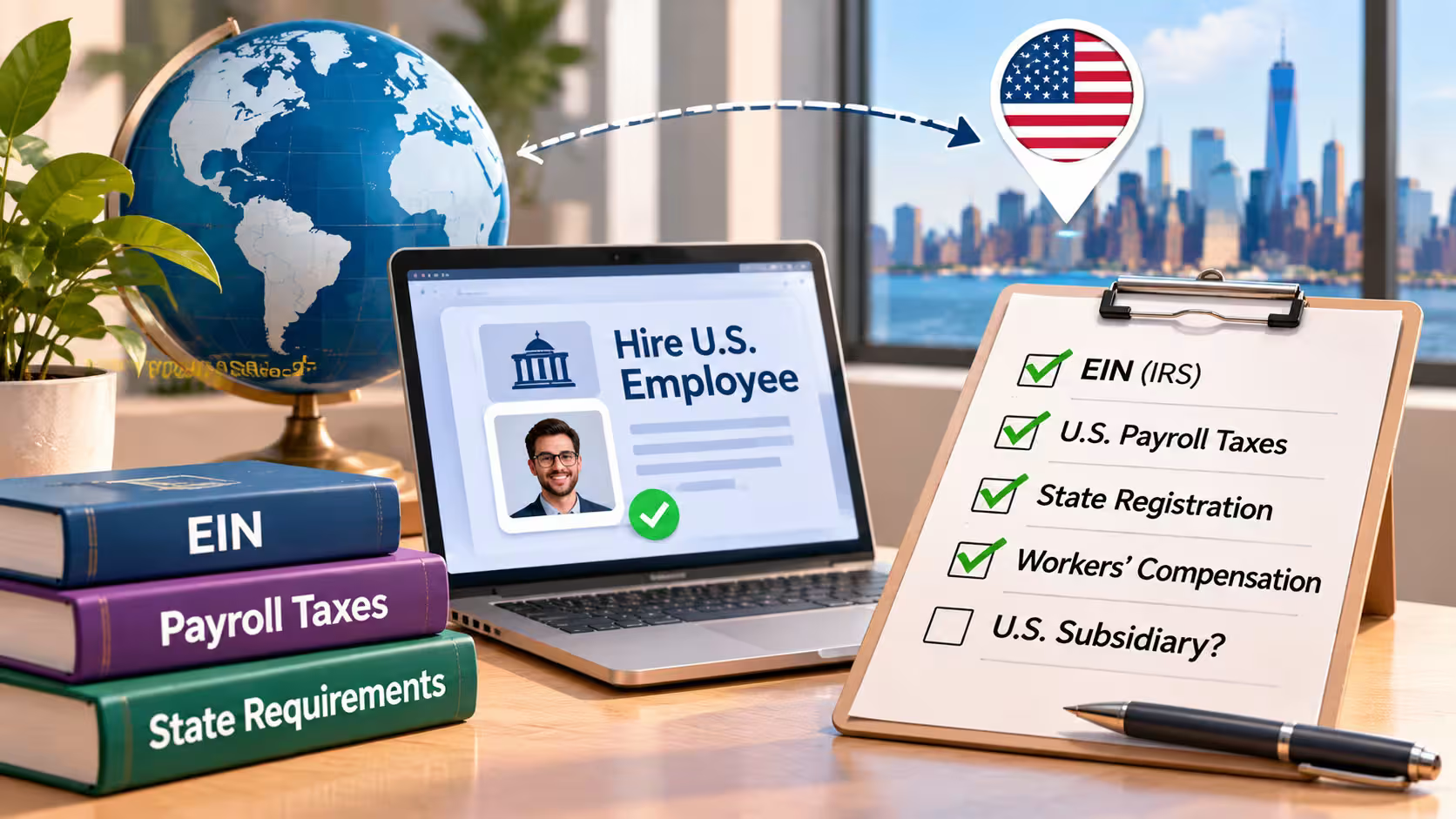
Can a foreign company hire a U.S. employee without forming a U.S. company? In some cases, yes. But a foreign company hire us employee ein setup often needs an EIN, state payroll accounts, and tax filings. The company must also choose how to manage payroll and meet U.S. employer rules.
Does a Foreign Company Need an EIN to Hire a U.S. Employee?
Generally, yes. A foreign company that pays wages to an employee working in the United States needs an Employer Identification Number (EIN) for federal employment tax reporting.
An EIN is a nine-digit number issued by the IRS. It identifies the employer for federal tax purposes. It is not the same as a state business registration or a personal Social Security Number.
An EIN for foreign employer use helps the IRS identify the company. The company may need one even if it has no U.S. subsidiary. State registration and other legal duties depend on where the employee works and what the company does there.
Read the IRS guide to Employer Identification Numbers for more information.
How Does a Foreign Company Apply for an EIN?
A foreign company can apply for an EIN using IRS Form SS-4. The form asks for details such as:
- The company's legal name and country of formation.
- Its mailing and business addresses.
- The name of its responsible party.
- The type of business entity.
- The reason for applying.
- The expected number of employees.
- The date the company expects to begin paying wages.
The responsible party is generally the person who owns or controls the company. It is usually an individual, not another company. If that person does not have and is not eligible for a U.S. Social Security Number or ITIN, the Form SS-4 instructions explain when to enter “foreign” or “N/A” on the responsible-party identification line.
Can an overseas company apply online?
Not always. A company whose principal place of business, office, or agency is outside the United States generally cannot use the IRS online EIN application.
International applicants can apply by telephone, fax, or mail. The IRS international EIN telephone number is 267-941-1099. Check the latest Form SS-4 instructions before applying.
What U.S. Payroll Taxes Must the Foreign Employer Handle?
U.S. payroll for foreign companies includes wage payments, tax withholding, tax deposits, and payroll reports. A foreign employer must follow the rules that apply to its workers and business activities.
Common federal payroll duties include:
- Federal income tax: The employer generally withholds income tax based on the employee's Form W-4.
- Social Security and Medicare: Employers generally withhold the employee's share and pay the employer's share of these taxes.
- Federal unemployment tax (FUTA): The employer may owe federal unemployment tax. The rules and credits depend on the facts.
- Payroll tax returns: Employers generally file Form 941 each quarter, unless the IRS assigns another filing schedule. Form 940 is used for annual FUTA reporting when required.
- W-2 reporting: Employers generally give Form W-2 to employees and file the required copy with the Social Security Administration.
Employers must also make payroll tax deposits on time. The deposit schedule depends on the employer's tax liability and IRS rules. Late deposits and missed filings can lead to penalties.
See IRS Publication 15, Employer's Tax Guide for current federal payroll rules, rates, and deadlines.
State Payroll Registration: A Separate Step
Getting a federal EIN does not register your company with every state. Your company may need separate state accounts before it pays the employee.
State rules depend on where the employee works. Your company may need these accounts and registrations:
- State withholding account: Used to report and pay state income tax taken from employee wages, where required.
- State unemployment account: Used to report wages and pay state unemployment contributions when required.
- Workers' compensation coverage: Many states require employers to have this insurance. Rules and exemptions vary.
- State business registration: Some states require a foreign company to register before doing business there.
- New hire reporting: Employers generally report new employees to the relevant state agency.
Do not assume that payroll registration also completes your company's registration with the state business authority. These can be separate steps.
Does Hiring One U.S. Employee Require a U.S. Subsidiary?
Not in every case. A foreign company may sometimes employ a U.S. worker directly without forming a U.S. subsidiary. But it must check the federal and state rules that apply.
Foreign company hiring US employees does not always mean the company must form a U.S. subsidiary. However, it may need state registration and payroll accounts before the employee starts work.
Hiring a U.S. worker can create state tax and registration duties. The worker's location and job duties matter. So does the work your company does in that state.
Before hiring, ask a U.S. business attorney or tax adviser if your company must register as a foreign entity in that state.
Should You Use a Payroll Provider?
A payroll provider can help a foreign company run U.S. payroll. It may calculate wages, withhold taxes, prepare reports, and help make tax deposits.
However, a payroll provider is not usually the legal employer. If your foreign company hires the worker directly, your company generally remains responsible for its employer duties.
Before choosing a provider, check that it can support foreign-owned employers. Ask if it can help with:
- Federal payroll tax setup and filings.
- State withholding and unemployment accounts.
- Payroll tax deposits and employee payslips.
- Year-end Forms W-2 and other reports.
- New hire reporting and payroll records.
Also ask which registrations the provider will handle. Find out which tasks remain your responsibility. Buying payroll software does not always complete state registration.
Employer of Record: An Alternative for Your First U.S. Hire
An employer of record (EOR) may help if your foreign company wants to hire one U.S. employee without running its own U.S. payroll operation.
An EOR is a third-party company that becomes the worker's legal employer under the EOR arrangement. It often handles payroll, tax withholding, employment documents, and some local employment duties. Your company usually directs the worker's daily tasks under a separate agreement.
An EOR can reduce the work involved in a first hire. It may be useful when you are testing the U.S. market or hiring one person in a state where you have no office.
Direct employment vs. an EOR
| Topic | Direct employment | Employer of record |
|---|---|---|
| Legal employer | Your foreign company | Usually the EOR |
| Payroll work | Your company or its payroll provider | Usually handled by the EOR |
| Employer registration | Your company checks and completes required registrations | Often handled by the EOR for the employment arrangement |
| Costs | Setup, payroll, insurance, and compliance costs | EOR fees and employment costs |
| Responsibilities | Your company has direct employer duties | Duties are shared under the contract and applicable law |
An EOR does not remove all legal or tax risks. Your company should still check its U.S. business activity and tax duties. Review the EOR contract too. Make sure it explains who handles payroll, benefits, and other duties.
Also check that the EOR arrangement is suitable for the role. It should not be used to hide a direct employment relationship or avoid duties that still apply to your company.
First U.S. Employee: A Practical Checklist
Review these steps before the employee starts work:
- Choose the hiring method: Decide between direct employment and an EOR.
- Confirm the work location: Find out which state the employee will work in.
- Check state rules: Review business registration, payroll tax, unemployment, and insurance duties.
- Apply for an EIN: Complete Form SS-4 if your company needs an EIN.
- Set up payroll: Choose a provider that supports your company and the employee's state.
- Collect employee forms: Get the employee's Form W-4 and complete Form I-9 as required.
- Report the new hire: Send the required details to the state agency.
- Set payroll dates: Plan pay periods, tax deposits, filing dates, and recordkeeping.
For more help with the EIN application and the person listed as the responsible party, read our EIN responsible party guide.
Common Mistakes Foreign Companies Should Avoid
- Using only a foreign tax number: A foreign tax ID does not replace a U.S. EIN when one is required.
- Registering only with the IRS: State payroll and business accounts may also be needed.
- Waiting until payday: Payroll setup and state registration can take time.
- Assuming the payroll provider is the employer: A payroll service does not usually take over your company's legal employer status.
- Ignoring workers' compensation: State insurance rules may apply even if you have only one employee.
- Skipping the EOR contract review: Check who handles payroll, benefits, insurance, and termination duties.
FAQs About Foreign Companies Hiring U.S. Employees
Can a foreign company hire a U.S. employee without a U.S. LLC?
Sometimes. A foreign company may employ a U.S. worker directly. But it must check federal and state employer rules. It may also need to register with the state where the employee works.
Can a foreign company get a U.S. EIN without a U.S. address?
Yes. A foreign company can apply for an EIN using Form SS-4. The form allows foreign addresses. Companies whose principal place of business, office, or agency is outside the United States generally cannot use the online application.
Does a foreign employer have to withhold U.S. payroll taxes?
Generally, wages for work performed in the United States are subject to U.S. employment tax rules. The exact duties depend on the worker, employer, and work arrangement.
Can a payroll provider apply for the EIN?
A company can name a third-party designee to help with an EIN application. The company must still provide correct information and understand the authorization it gives.
Is an EOR better than direct employment for one U.S. employee?
It depends on the cost, the employee's state, and your plans. An EOR may make the first hire easier. Direct employment may suit a company that plans to build a larger U.S. team.
Conclusion: Plan Your Foreign Company Hire US Employee EIN Setup
A foreign company hire us employee ein setup involves more than getting an EIN. Your company may also need federal payroll filings, state tax accounts, and workers' compensation coverage.
Before hiring, compare direct employment with an employer of record. If your company hires directly, check the rules in the employee's state. Choose a payroll provider that can support foreign employers.
Planning ahead can help your company pay its first U.S. employee and meet its tax duties.