
The Exact Documents U.S. Banks Ask Foreign Founders For (EIN Letter, Articles, Passport)
Opening a U.S. business account from abroad? Compare the documents Mercury, Relay, Wise, Bluevine, and Chase request from foreign founders.
- #Banks
- #EIN Letter
- #Foreign-Owned LLC
- #Non-Resident Business Banking
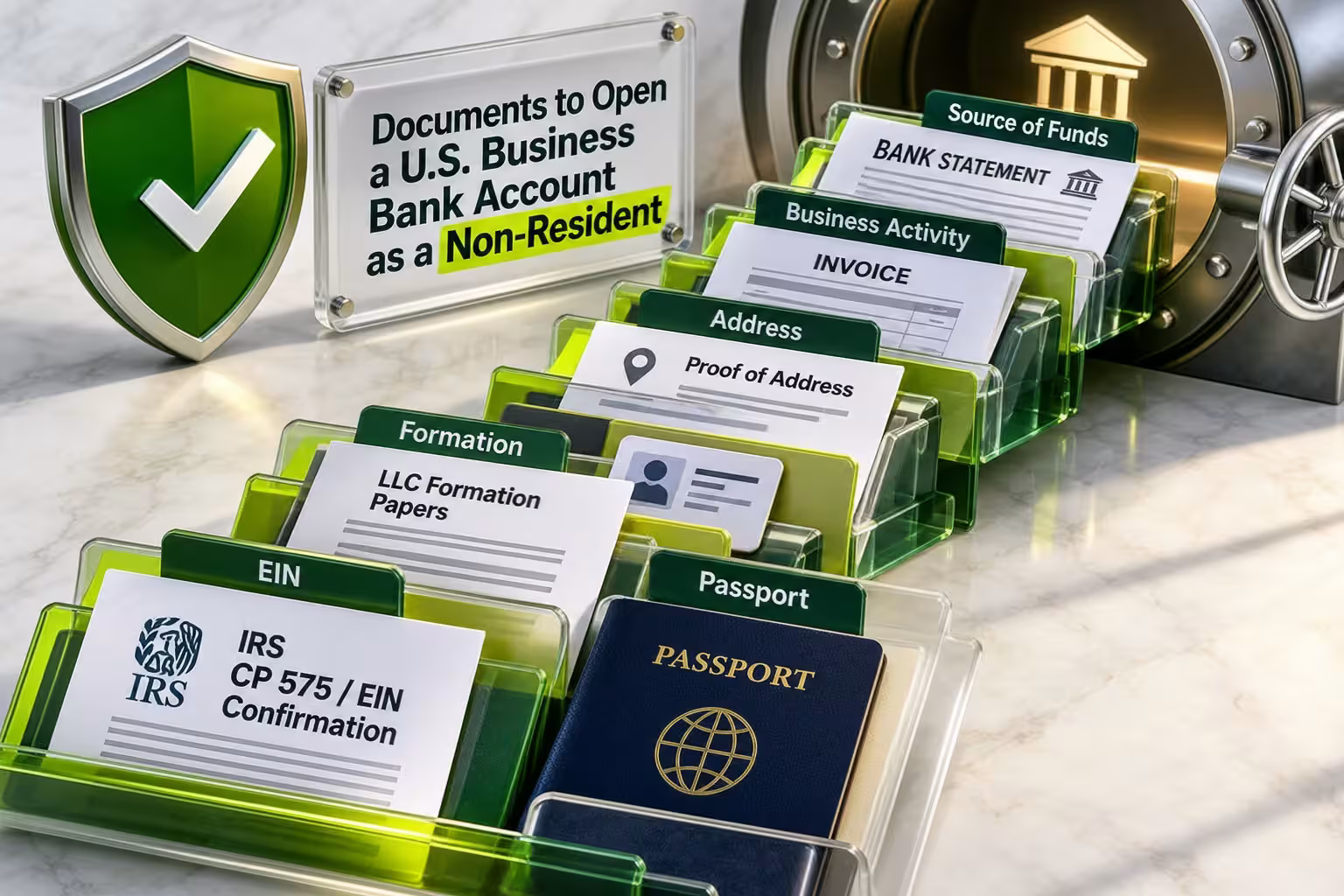
The documents to open US business bank account non resident founders need often include an IRS EIN letter, company formation papers, a passport, and proof of business details. The exact documents depend on the bank or payment provider.
This guide compares the document rules published by Mercury, Relay, Wise Business, Bluevine, and Chase. It explains which EIN letters each provider lists and what else you may need. Rules and country lists can change, so check the provider’s latest requirements before you apply.
Documents to Open US Business Bank Account Non Resident Founders Need
These documents help prove who owns the company, what the business does, and where its money comes from. Prepare clear copies before you apply. The provider may also check some details online.
- IRS EIN letter: This may be CP 575, Letter 147C, or an SS-4 returned by the IRS. The accepted format depends on the provider.
- Company formation papers: These include state-filed Articles of Organization for an LLC or Articles of Incorporation for a corporation. Some states use the name Certificate of Formation.
- Operating Agreement: This is useful for an LLC. It shows the owners, their shares, and who manages the company. A provider may ask for it during review.
- Passport: Prepare a valid passport for each owner or control person the provider asks to check.
- Owner details: Prepare each owner’s full legal name, date of birth, home address, and ownership share. Also know who runs the company.
- Address proof: Prepare proof of the company’s real business address. You may also need proof of each owner’s home address.
- Proof of business activity: This may include your website, customer contracts, invoices, service details, or supplier records.
- Proof of funds: Prepare bank statements, investment records, invoices, or loan papers. These should show where the business gets its money.
Do not assume that a registered-agent address will be accepted as your business address. Some providers need a real place where the business operates. They may reject P.O. boxes, mail drops, or virtual mailbox addresses.
Which EIN Letters Do the Providers Accept?
An EIN letter is an important part of a business account application. But providers do not all publish the same rules. The table below lists what their public guidance says.
“Not specified” does not mean the provider rejects the document. It means its public page does not clearly say whether that format is accepted.
| Provider | Published EIN proof | CP 575 | Letter 147C | IRS-returned SS-4 |
|---|---|---|---|---|
| Mercury | CP 575, Letter 147C, or an SS-4 returned by the IRS. It may also accept an IRS website EIN confirmation screenshot in some cases. | Listed | Listed | Listed |
| Wise Business | Lists an IRS-filed and returned document. Common examples are Letter 147C and Form SS-4. | Not listed on its EIN checks page | Listed | Listed, if returned by the IRS |
| Relay | Requires the company EIN and formation papers. Its reviewed checklist does not name a specific IRS letter. | Ask Relay | Ask Relay | Ask Relay |
| Bluevine | Requires an EIN or tax ID for an LLC or corporation. Its public guidance does not name the accepted letter types. | Ask Bluevine | Ask Bluevine | Ask Bluevine |
| Chase | Requires a tax ID, which may include an EIN. Its public checklist does not give one rule for CP 575 and Letter 147C. | Ask the branch | Ask the branch | Ask the branch |
Important: “Ask the provider” does not mean the document will be rejected. It means the public rules do not clearly name that document. Ask which IRS letter they accept before you apply.
Mercury: CP 575, Letter 147C, and Returned SS-4
Mercury has one of the clearest public lists of EIN documents for U.S.-registered companies. It lists CP 575, Letter 147C, and an SS-4 returned by the IRS.
Mercury says the SS-4 must be the copy returned by the IRS. The form you sent to the IRS is not enough. Mercury may also accept an EIN confirmation screenshot from the IRS website in some cases.
Other Mercury documents
- State-filed Articles of Organization, Articles of Incorporation, or Certificate of Formation.
- Passport for international applicants who need to prove their identity.
- ID for each owner with at least 25% ownership and at least one person who controls daily business activity.
- Business and owner address details.
- Details about the business, its source of funds, and current or planned U.S. activity.
Mercury accepts some companies owned by people who live outside the United States. The company must be formed in the U.S. and have current or planned U.S. business activity. Mercury does not accept every country, business type, or address. Check its latest rules before you apply.
Relay: Prepare Your EIN and Company Formation Papers
Relay asks for the company EIN and formation papers. These may include Articles of Organization or Articles of Incorporation.
Relay also asks for owner details and information about the business. This may include its source of funds, countries where it operates, U.S. business links, expected payment volume, and reason for opening the account.
Relay’s public checklist reviewed for this article does not say whether it accepts CP 575, Letter 147C, or a returned SS-4 as proof. If you have only one of these documents, ask Relay if it will accept it before you apply.
Other Relay documents and checks
- Formation papers for your type of company.
- Passport and owner details for non-U.S. owners.
- Physical address details. Relay says it does not accept P.O. boxes or virtual mailboxes for the relevant address checks.
- Details about the company’s U.S. business activity and the owner’s country of residence.
Relay accepts some U.S.-registered companies owned by non-U.S. citizens or residents. The company must have a business presence in the United States, and its owners must live in supported countries. Approval is not automatic. Check Relay’s latest country and business rules before you apply.
Wise Business: Letter 147C and Returned SS-4
Wise says its EIN check document must be filed with and returned by the IRS. It names Letter 147C and Form SS-4 as common examples.
The business name and EIN on the document must match the details on your Wise Business account. Wise’s EIN checks page does not name CP 575. Ask Wise if it will accept your CP 575 for the check you need to complete.
Other Wise Business documents
- Business legal name, company type, registration number, and EIN.
- Registered business address and a separate physical trading address.
- Proof of the trading address, if requested. Wise says it does not accept P.O. boxes, registration agencies, mail forwarding services, or virtual addresses as a trading address.
- Details of people who own 25% or more of the company or control it. These may include full name, date of birth, home address, email, and job title.
- Photo ID for non-U.S. owners. Wise may ask for SSN details from owners who live in the U.S. or hold a U.S. passport.
- Business activity, website or online store, reason for using Wise, and expected monthly payment amounts.
Wise is a financial services provider, not a traditional U.S. bank. Its services and checks may depend on the company’s state, business type, owners, and location.
Wise says it cannot onboard businesses from Nevada and some U.S. territories under its current public rules. Check its latest requirements for your company before applying.
Bluevine: EIN Required, but Letter Types Are Not Listed
Bluevine says an LLC or corporation must provide an EIN. Its public application guide also asks for the legal business name, physical business address, phone number, industry, and yearly revenue.
International applicants may need to provide passport details and a passport image. Owners with 25% or more of the company may also need to provide their ID, home address, date of birth, and ownership share.
The Bluevine pages reviewed for this article do not say whether CP 575, Letter 147C, or a returned SS-4 is accepted. If you plan to apply with one of these documents, ask Bluevine which format it needs.
Check Bluevine’s rules for international applicants
Bluevine’s current guidance says applicants must live in the United States or a supported country, own or represent a U.S.-registered business, and pass identity checks.
It may ask international applicants for passport details and a passport image. Check the supported-country list and business rules first. Not every foreign founder can apply.
Chase: EIN, Formation Papers, and Personal ID
Chase asks for a tax ID as part of its business checking application. This may be an EIN, SSN, or ITIN, based on the business and applicant.
Chase also asks for legal papers that show the company exists. These may include Articles of Organization or a Certificate of Formation.
For online applications, Chase asks for details about owners with 10% or more of the company. These details may include legal name, address, date of birth, tax ID, citizenship, and ownership share.
For branch applications, Chase says applicants may need two forms of personal ID. One must be government-issued. Applicants may also need the business tax ID and formation papers.
Chase lists passport options for some non-U.S. citizens who are not permanent residents. However, its public guidance does not give one rule for accepting CP 575 or Letter 147C at every branch.
Chase is a traditional bank. Its rules may depend on the branch, company type, and applicant. If you live outside the U.S., contact the branch or business banking team before you travel. A general document list does not mean every foreign-owned LLC will be approved.
CP 575 vs. Letter 147C vs. Returned SS-4
The IRS explains how to apply for and receive an Employer Identification Number on its official EIN page. The IRS issues the EIN. Banks and financial providers set their own rules for checking your documents.
- CP 575: This is the IRS notice that confirms your new EIN. Keep the original letter or PDF in a safe place. A bank or payment provider may ask for it.
- Letter 147C: This letter confirms an EIN that the IRS has already issued. You can ask the IRS for it if you lose the CP 575. Each provider decides whether it will accept the letter.
- Returned SS-4: Form SS-4 is the EIN application. Some providers accept a copy returned by the IRS that shows the assigned EIN. A blank form or an application that has not been processed is not proof of an EIN.
The document must show the correct legal company name and EIN. These details should match the bank application and state formation papers.
How to Prepare Your Documents Before Applying
If you are a non-U.S. owner setting up a U.S. company, our guide to getting an EIN for a foreign-owned LLC explains the EIN process and key points for overseas owners.
Use this checklist to prepare the documents to open US business bank account non resident applicants may be asked to provide:
- Check the company name. Compare the name on the state papers, IRS EIN letter, and bank application. Fix spelling or punctuation differences before you apply.
- Prepare your EIN proof. Keep CP 575 ready if you have it. If it is missing, ask the IRS for Letter 147C. If the provider accepts a returned SS-4, use the copy sent back by the IRS with the EIN.
- Gather company papers. Get the state-filed Articles and filing confirmation. Keep your Operating Agreement ready, even if the provider does not list it as a standard document.
- Check owner details. Use the same legal name, date of birth, home address, and ownership share across the forms and records.
- Prepare address proof. Your registered address may not be the same as your business address. Check if the provider needs proof of a physical trading address or an owner’s home address.
- Explain your business. Prepare a short and clear description of what the company does. You may also need a website, sample invoice, or customer contract.
- Show where the money comes from. Prepare bank statements, investment records, invoices, or loan papers. These should match the business activity and payment amounts in your application.
- Check country rules. Review the supported-country list for the owner’s country of residence. Also check the provider’s rules for business type, industry, and U.S. activity.
- Ask about unclear EIN letters. If the provider does not say whether it accepts CP 575, Letter 147C, or a returned SS-4, ask before you apply.
Common Document Mistakes That Delay Applications
- Sending an SS-4 application instead of the IRS-returned copy: A form you sent to the IRS does not prove that the IRS assigned an EIN.
- Using different company names: The IRS letter, state papers, and bank form should show the same legal company.
- Using only a registered-agent address: Some providers need a real business or trading address.
- Leaving out owners: A provider may ask for people who own or control the company through another business.
- Sending a poor passport scan: Use a clear image of a valid passport when asked.
- Giving unclear business details: Explain your customers, services, suppliers, countries, and expected payments.
- Assuming every provider accepts the same EIN letter: The rules differ. Ask if the provider does not name your document.
Frequently Asked Questions
Can I open a U.S. business bank account with only my EIN letter?
Usually, no. You should also prepare company formation papers, owner ID, address details, and a clear description of the business. Some providers may ask for an Operating Agreement or proof of funds.
Does every bank accept CP 575?
No. Mercury lists CP 575. Wise names Letter 147C and a returned SS-4 on its EIN checks page, but does not name CP 575 there. The public guidance reviewed for Relay, Bluevine, and Chase does not list every accepted EIN letter.
Is Letter 147C the same as CP 575?
No. Both can confirm an EIN, but they are different IRS letters. CP 575 is usually sent when the IRS assigns the EIN. Letter 147C can be requested later if you need proof of an existing EIN.
Can I use a passport instead of an SSN?
Some providers accept a foreign passport to check the identity of non-U.S. owners. But a passport does not replace the company EIN or meet every tax ID rule. The exact requirements depend on the provider and applicant.
Do I need an Operating Agreement?
It is a good idea to prepare one for an LLC, especially if it has more than one owner. It shows who owns and manages the company. A provider may ask for it during its review.
Can I use my registered-agent address?
Do not assume that you can. Mercury and Wise separate a registered or mailing address from a physical business or trading address. Other providers may also ask for a real business location. Check the rules before applying.
Final Takeaway
Most foreign founders should prepare an IRS EIN letter, state-filed company papers, a valid passport, owner details, address proof, and clear business and funding records. These are the main documents non-residents should gather before they apply for a U.S. business bank account.
Mercury has the clearest public list of accepted EIN documents. Wise names Letter 147C and an IRS-returned SS-4 for EIN checks. Relay, Bluevine, and Chase require an EIN or tax ID but do not list every accepted letter type in the guidance reviewed.
Before you apply, check that your country is supported and ask which EIN document the provider accepts. Having all your documents ready can make the process easier, but it does not guarantee approval.