
Why Banks Reject Foreign-Owned LLCs: 10 Red Flags and How to Fix Them
Did a bank reject your foreign-owned U.S. LLC? Learn 10 issues that can trigger extra checks or rejection, how to fix each one, and what to prepare before applying again.
- #Bank Rejec
- #Business Bank Account
- #Foreign-Owned LLC
- #Non-Resident LLC
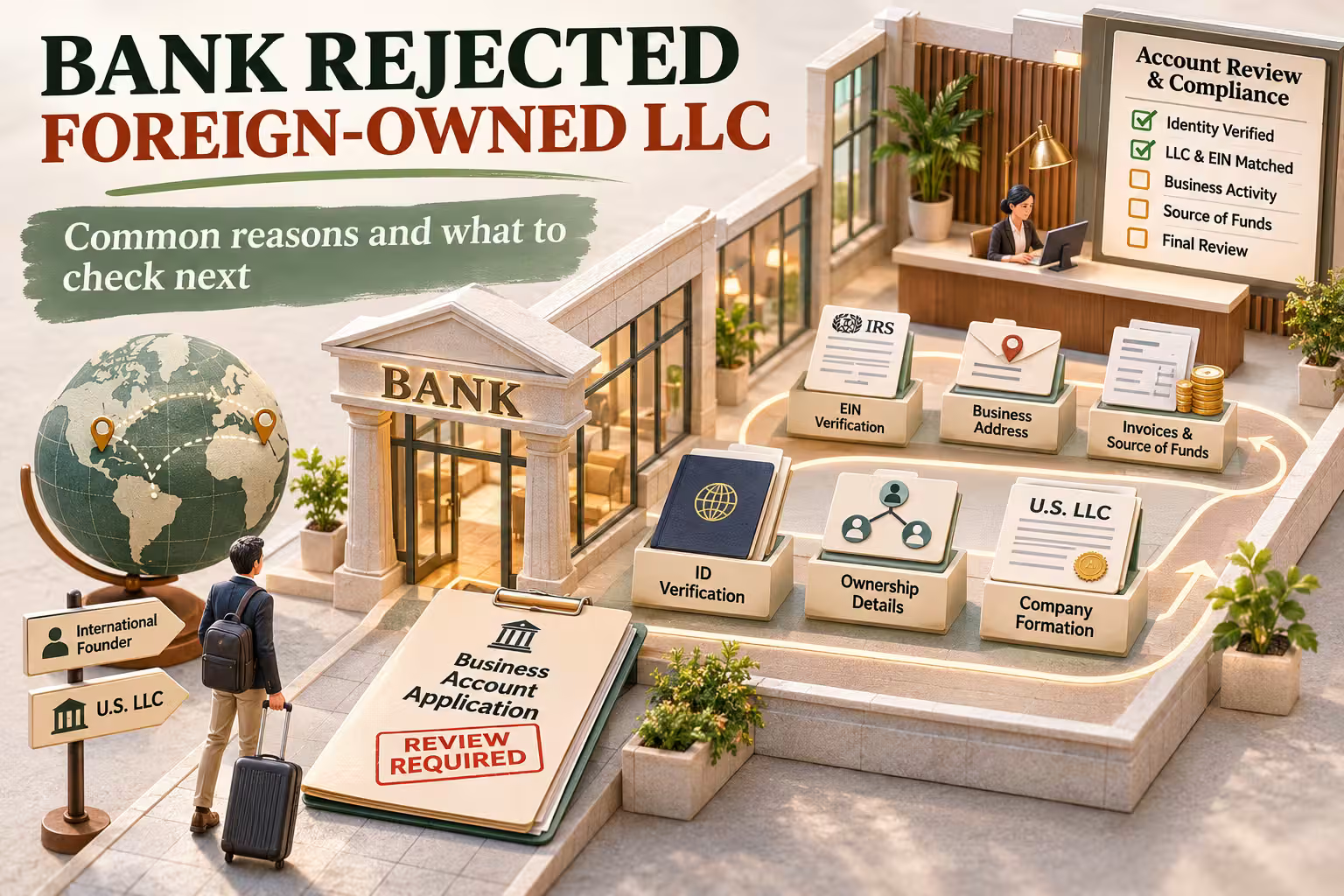
A bank rejected foreign owned LLC applications for several common reasons: unclear ownership, weak proof of U.S. operations, address problems, missing tax records, or unexplained funds. A U.S. LLC and EIN do not guarantee a business bank account. Banks must check the company, its owners, and the planned use of the account.
This guide covers 10 practical red flags, why they can lead to extra review or rejection, and what foreign founders can do before applying again. If you are researching a bank account rejected foreign LLC situation, use the steps below to identify what may have gone wrong. The list is a troubleshooting guide, not a ranking based on private bank rejection data.
Why a Bank May Reject a Foreign-Owned LLC
Opening a business account is not only a check of the LLC’s state registration. Banks also review the people who own or control the company, where the business operates, what it sells, and where its money comes from. Understanding why banks reject LLC applications starts with these checks: approval depends on more than having a U.S. registration and EIN.
For example, U.S. banks covered by FinCEN’s Customer Due Diligence (CDD) rules must identify and verify beneficial owners of many legal-entity customers. FinCEN describes an ownership threshold of 25% or more, plus one person with significant control. A bank may ask for more information based on its own risk rules.
Bank-specific rules can be stricter. Chase, for example, says it may collect details for each business owner with 10% or more ownership, including name, address, date of birth, tax ID, citizenship, and ownership share. So prepare for the exact bank’s checklist, not just the federal minimum.
10 Red Flags That Can Lead to a Bank Rejection
1. The bank does not support the owner’s country
Some banks and fintech providers limit applications based on where an owner lives. These limits can apply even when the LLC is registered in the United States. A provider may also restrict a company if it operates in a prohibited country.
How to fix it: Check the bank’s current supported-country and prohibited-country lists before applying. Check the residence of every owner and controller, not only the applicant. For example, Mercury says its country restrictions are based on residence, not citizenship. Relay also requires owners to live in supported countries.
2. The LLC has no clear U.S. business activity
A U.S. formation certificate does not prove that the company has real U.S. operations. A bank may ask where the company sells, who its customers are, where its suppliers are, and what work it performs in the United States.
How to fix it: Prepare a short business summary. Explain what the LLC sells, who pays it, where customers are located, how it delivers its service, and what U.S. activity it has or plans to start. Provide real contracts, invoices, supplier records, or a business plan if requested. Do not claim to have U.S. staff, an office, or customers if you do not.
3. The address is only a registered agent or mail service
A registered agent address is used to receive legal notices. It may not be accepted as the company’s operating or principal business address. Some providers also reject P.O. boxes, virtual mailboxes, and commercial mail-receiving addresses.
How to fix it: Read the provider’s address rules. Use a real business location or another address type the bank accepts. Be ready to show proof, such as a lease, utility bill, or other document requested by the bank. Do not label a registered agent address as an office if the business does not operate there.
4. Owner details do not match across documents
A different spelling of a name, old address, wrong date of birth, or conflicting ownership percentage can stop verification. The bank may compare the application with passports, company records, IRS letters, and ownership documents.
How to fix it: Make one accurate owner information sheet before applying. Use the same legal name and date of birth shown on each person’s ID. Check addresses and ownership percentages. If a person has changed their name or address, prepare the supporting record.
5. The beneficial owners are not fully disclosed
Some founders list only the person submitting the application. Banks may also need details about people who own part of the LLC or control it through another company. FinCEN’s CDD guidance refers to individuals who own 25% or more and one person with significant control. Individual banks can ask for information at lower ownership levels.
How to fix it: Prepare a full ownership chart. Show each direct and indirect owner, the percentage held, and any parent or holding company. Identify the person who manages or controls the LLC. Do not use a nominee or leave out an owner to make the application look simpler.
6. The EIN or company name cannot be verified
The bank may be unable to match the EIN to the legal business name. This can happen when the application uses a trade name instead of the LLC’s legal name, a typo appears in the EIN record, or the applicant uploads an incomplete or unclear IRS notice.
How to fix it: Use the exact legal name shown on the IRS EIN record and formation documents. Upload a clear, complete IRS confirmation letter if requested. If the EIN letter is missing, ask the IRS about an EIN verification letter, such as Letter 147C. If the IRS record itself is wrong, resolve that issue before applying again.
7. The source of funds is unclear
A bank may ask where the first deposit and future business funds will come from. A vague answer such as “business income” may not explain a large transfer from a personal account, an overseas company, an investor, or a third party.
How to fix it: Describe the source in plain language and support it with records. Examples include customer invoices, signed contracts, investor documents, sale records, or bank statements. Explain why the funds are being sent from another country or account. Never split transfers or change descriptions to avoid questions.
8. The business activity is restricted or hard to understand
Providers do not all support the same industries. Some restrict money services, gambling, adult services, cannabis, or other higher-risk activities. A vague website or unclear description can also make it hard for the bank to understand what the company does.
How to fix it: Check the bank’s restricted-industry list before applying. Describe the actual product or service, how customers pay, and how the company delivers it. Make sure your website, invoices, application, and business documents tell the same story. Do not hide the real activity behind a broad label such as “consulting” or “technology.”
9. The application has missing or poor-quality documents
Blurry passport images, cropped IRS letters, expired IDs, missing formation records, or unsigned agreements can delay review. A bank may close an application if required information is not supplied in time.
How to fix it: Use a document checklist for the exact entity type. Upload full-page, readable files. Check expiry dates and make sure every page is included. Keep digital copies of the formation certificate, operating agreement, EIN notice, ownership chart, address proof, and owner IDs ready.
10. The expected account activity does not make sense
A bank may ask how much money the LLC expects to receive, how often it will send payments, which countries it will deal with, and who its main customers or suppliers are. If the answers do not fit the business model, the bank may ask for more proof.
How to fix it: Prepare a realistic monthly estimate. Explain typical deposit sizes, payment frequency, countries involved, and major expense types. Make sure the estimate matches the company’s stage and records. Update the bank if the business later changes in a major way.
Bank Rejected Foreign Owned LLC: What to Do Next
If a bank rejected your foreign owned LLC, do not send the same application to several providers without fixing the problem. A bank rejected foreign owned LLC case should be treated as a verification or eligibility issue first. Identify whether the issue was country eligibility, business activity, ownership, address, identity, tax records, or source of funds. First, identify whether the issue was country eligibility, business activity, ownership, address, identity, tax records, or source of funds. This is especially important after a foreign-owned LLC bank account denial, because the next provider may apply different eligibility and verification rules.
- Read the rejection notice. Save the email or dashboard message. Note whether the bank gave a specific reason or asked for more documents.
- Ask what can be corrected. If the reason is unclear, contact the provider and ask whether the issue is missing information or an eligibility restriction.
- Check every owner. Confirm each person’s residence country, legal name, ID, address, ownership share, and role.
- Match the company records. Compare the legal name and address on the state formation record, EIN notice, operating agreement, and application.
- Prepare proof of real activity. Gather contracts, invoices, website details, supplier records, and a clear description of the business.
- Explain money flows. Document where opening funds come from and how the account will be used.
- Apply only where eligible. Confirm the provider supports the owner’s country, business type, industry, and address before submitting another application.
Which Providers May Consider Foreign-Owned U.S. LLCs?
Eligibility differs by provider and can change. These examples show why you should read each provider’s current rules rather than assume that all U.S. business accounts accept overseas owners.
Mercury
Mercury says it supports many U.S.-registered companies with founders living outside the U.S. The company must have existing or planned U.S. operations and a principal business address. Mercury does not accept a registered agent address, P.O. box, or UPS Store address as the principal business address. It also restricts owners who live in certain countries and some business types.
Relay
Relay says applicants need a business registered and operating in the U.S., a supported industry, and owners who live in supported countries. It asks for business and beneficial-owner details during the application. Check the current restricted-country list before applying.
Chase
Chase publishes a document process for business owners, including details for owners with 10% or more of the business. It may ask for legal name, address, date of birth, tax ID, citizenship, and ownership percentage. Some entity types must apply at a branch. Confirm the bank’s rules for your exact company and residence situation.
For a broader comparison, read our guide to U.S. business accounts for non-resident LLC owners and our guide to Mercury application and EIN verification problems.
Frequently Asked Questions
Does having a U.S. LLC and EIN guarantee bank approval?
No. The LLC and EIN identify the business, but the bank also checks the owners, business activity, address, source of funds, and expected account use. Each provider has its own eligibility rules.
Can a foreign owner use a passport instead of an SSN?
Some banks and providers accept a passport or other foreign identification for non-U.S. owners. The exact tax ID and identity rules depend on the provider and the owner’s situation. Ask the bank what it needs before applying.
Does a registered agent address work for a business bank account?
Not always. Some providers do not accept a registered agent address as the principal business address. Check the bank’s address policy and use a real address that meets its rules.
Can I apply to another bank after a rejection?
Yes, if the next bank supports your company and owners. First fix any errors and check the new provider’s country, industry, address, and document rules. A rejection by one provider does not mean every bank will reject the LLC.
Will changing the LLC address fix a rejected application?
Only if the address was the real issue and the new address meets the bank’s rules. Do not use a false address or rent a mailbox just to pass verification. The bank may ask for proof that the business or owner can be reached at that location.
Final Takeaway
A bank rejection does not always mean the LLC is invalid. It may mean the provider cannot verify an owner, address, business activity, EIN, or source of funds—or that the company falls outside its eligibility rules. Find the exact issue, correct the records, and apply only to a provider that supports your country and business model.
This article gives general banking information, not a promise of account approval or legal advice. Bank policies and country lists can change. Check each provider’s current rules before applying.